
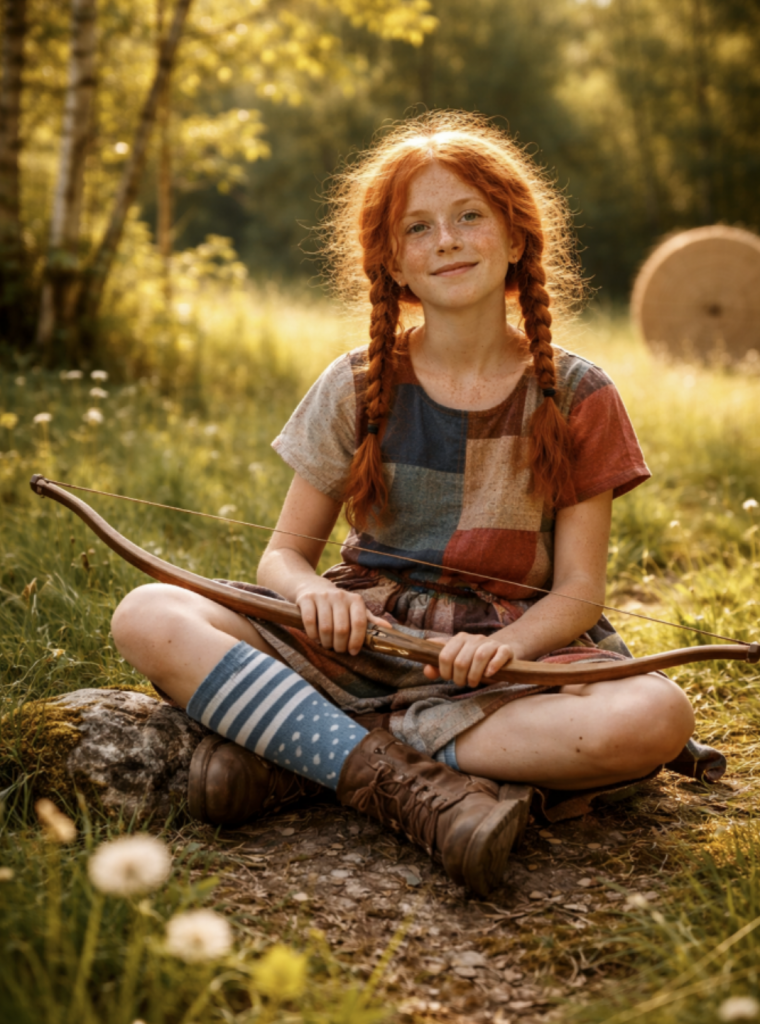
No target you have to hit
I often see the same picture when a woman picks up a bow for the first time. Shoulders pulled up. Forehead creased. A look already searching for the result before the arrow has even flown.
I know that look. It comes from a very different life than the one that unfolds here, among the islands off Stockholm. It comes from performance reviews, from parent-teacher evenings, from the quiet calculation so many women run every single day: Am I a good mother and wife. Am I a good colleague. Was what I got done today enough.
Most of the time I say nothing about it. I simply hand over the bow.
A device with no opinion
A traditional bow has no sight. No computer working out an angle. No menu giving feedback. There is only the arrow, the target – and you.
What I like about the arrow is that it is honest, but never judging. It flies exactly as you let it. Not worse, not better – just a messenger, carrying back what was really happening in you a moment ago. No grade. No score from an annual review. Just feedback from a single moment.
What you learn here is not aiming
I often tell my students: your body already knows how to do this. It knew how to grip, how to throw, how to align itself, long before anyone told you how you were supposed to be. In instinctive archery, I wake that old knowledge back up.
The head wants to control. It calculates, corrects, second-guesses. But an arrow cannot be steered by the head – it trembles when there is too much thinking. It isn’t the head that hits the mark, but the trust standing behind it.
So I don’t have my students aim in the classical sense. I have them find a reference point instead – a spot on the face where the draw hand rests, always the same, always reliable. Everything else isn’t calculation. Everything else is opening: I open the back, I rise into that quiet T the body forms at full draw – bow arm, shoulders, draw hand, one straight line between two points, carrying weight without a fight.
And then comes the moment I love most. The moment nothing more needs to happen. I don’t force the shot. I allow it.
A space without judgment
In my courses I have girls from the age of eight, who don’t yet know how loudly the world will one day judge them. And I have women who already know it all too well – who, between calendars, kitchens, and conference rooms, can barely find a moment when nobody wants anything from them.
For both, the same rule applies here: nobody has to be good enough. Nobody has to look strong to be strong – the draw weight of a bow is a matter of technique, not muscle. A grip as light as a sparrow’s on a branch: firm enough to hold, loose enough not to hurt. Nothing more is needed.
Then I see something familiar happen. A woman who otherwise functions every single day stands there, breathes out, allows the shot – and for the first time in weeks doesn’t think: Am I enough. But instead: I am here.
And yes – whoever finds that state also hits the mark. More often than you’d think. But that isn’t the goal. That is only what’s left over, once you stop distrusting yourself.