
Long before fitness influencers, wearable technology, or gym memberships, people were already searching for the same thing we seek today: a way to become healthier without turning exercise into another obligation.
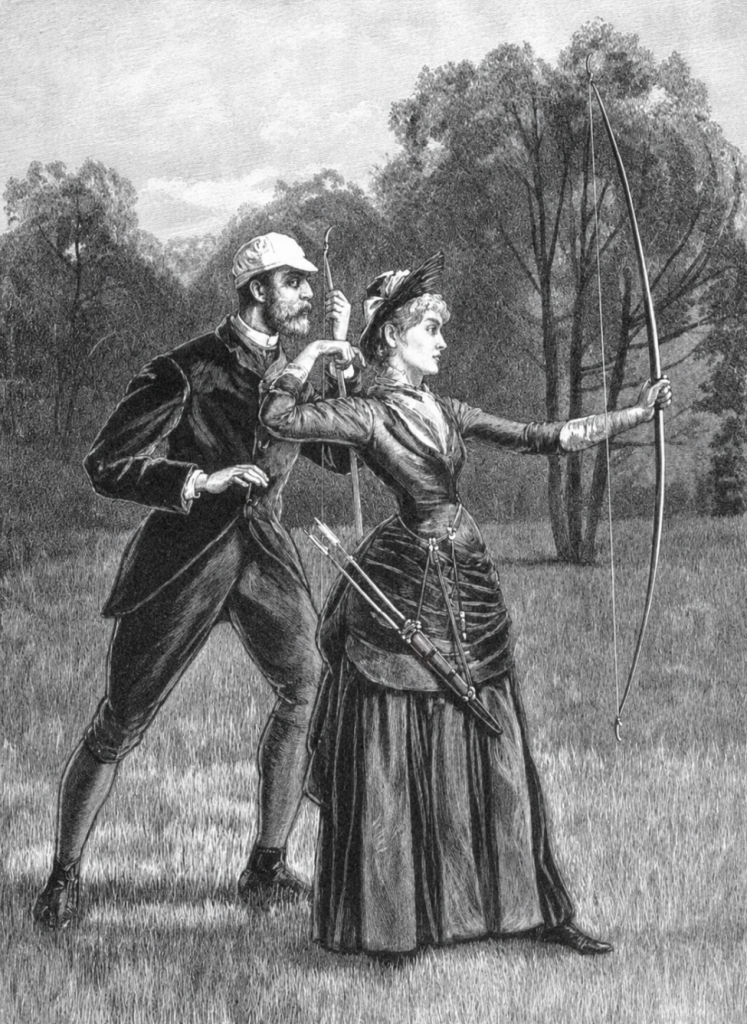
In June of 1888, Henry Chadwick—best known as the pioneering sportswriter who helped shape modern baseball—published an article in Outing Magazine titled „The Experience of a Novice.“ It wasn’t about competition or records. It was the story of a man discovering archery later in life, and in doing so, discovering a completely different philosophy of exercise.
One passage stands out more than a century later.
Describing the benefits of archery, Chadwick wrote that it was especially advantageous for „men of sedentary habits, and to the fair sex.“ The language belongs to the nineteenth century, but the idea is surprisingly modern. He believed that people whose daily lives lacked natural movement could regain strength through an activity that was enjoyable rather than obligatory.
Then came the sentence that still feels remarkably fresh today:
„There is quite a difference between the mechanical work of calisthenic movements and the pleasurable excitement incident to trials of skill on the archery field… In comparison, one is work, and the other is play.“
That simple observation anticipated a principle that modern science would not fully explain for another hundred years.
Today, psychologists speak of intrinsic motivation—the idea that people are far more likely to continue an activity when they genuinely enjoy it. According to Self-Determination Theory, developed by Edward Deci and Richard Ryan, lasting motivation comes not from pressure or discipline alone, but from experiencing autonomy, competence, and enjoyment. Chadwick didn’t know those terms, but he understood the principle intuitively.
Modern research also shows that exercise adherence—the ability to keep exercising over months and years—is strongly influenced by enjoyment. The most effective exercise is often not the one that burns the most calories or builds the most muscle. It is the one people actually want to return to.
Archery offers exactly that.
Every arrow presents a new problem to solve. Every shot provides immediate feedback. Improvement becomes the reward. Instead of counting repetitions, the archer becomes absorbed in the process itself.
This idea extends beyond motivation.
Research in motor learning has shown that the brain learns movement most effectively through meaningful tasks, variable practice, and continuous sensory feedback rather than through endless mechanical repetition. Every shot in archery is slightly different. Wind changes. Distance changes. Posture changes. The brain is constantly adapting.
Neuroscience tells a similar story.
Every time an archer draws the bow, coordinates posture, controls breathing, judges distance, and releases the string, networks throughout the brain are engaged simultaneously. Through neuroplasticity, these repeated experiences gradually refine perception, coordination, balance, timing, and movement. What appears to be „just shooting arrows“ is, in reality, a remarkably rich learning process.
Even the physical effects described by Chadwick have stood the test of time.
Drawing a traditional bow engages the muscles of the back, shoulders, arms, and trunk in coordinated movement rather than isolated contractions. Postural control, stability, and body awareness improve together. Strength develops naturally—not because strength is the goal, but because it becomes a consequence of pursuing skill.
Chadwick also recognised something unusual for his time.
He described archery as one of the most beneficial forms of exercise for women. At a time when opportunities for vigorous outdoor recreation were limited, archery offered an activity that rewarded precision, coordination, confidence, and practice rather than brute force. In many respects, it provided a rare opportunity for physical independence.
More than 130 years have passed since Chadwick wrote those words.
Today we explain them with terms such as intrinsic motivation, motor learning, neuroplasticity, and exercise adherence.
Chadwick simply called it play.
Perhaps that is why his article still resonates today. Archery does not disguise exercise.
It transforms exercise into something we willingly choose. And perhaps that has always been the secret.
Not finding a workout we can endure — but finding one we never want to stop.
References
- Chadwick, H. (1888). The Experience of a Novice. Outing Magazine, Vol. XII, No. 3, pp. 207–210.
- Deci, E. L., & Ryan, R. M. (1985). Intrinsic Motivation and Self-Determination in Human Behavior. Plenum Press.
- Ryan, R. M., & Deci, E. L. (2020). Intrinsic and Extrinsic Motivation from a Self-Determination Theory Perspective. Contemporary Educational Psychology, 61.
- Schmidt, R. A., Lee, T. D., Winstein, C. J., Wulf, G., & Zelaznik, H. N. (2019). Motor Control and Learning: A Behavioral Emphasis. Human Kinetics.
- Bernstein, N. A. (1967). The Coordination and Regulation of Movements. Pergamon Press.
- Doidge, N. (2007). The Brain That Changes Itself. Viking.
- Merzenich, M. M. (2013). Soft-Wired: How the New Science of Brain Plasticity Can Change Your Life. Parnassus Publishing.
- Wolpert, D. M. (2011). „The Real Reason for Brains.“ TEDGlobal Talk.
- Teik Hong, T., et al. (2024). Postural Adjustments in Archery Performance: Evidence from Anticipatory Motor Control. (Preprint). arXiv.