
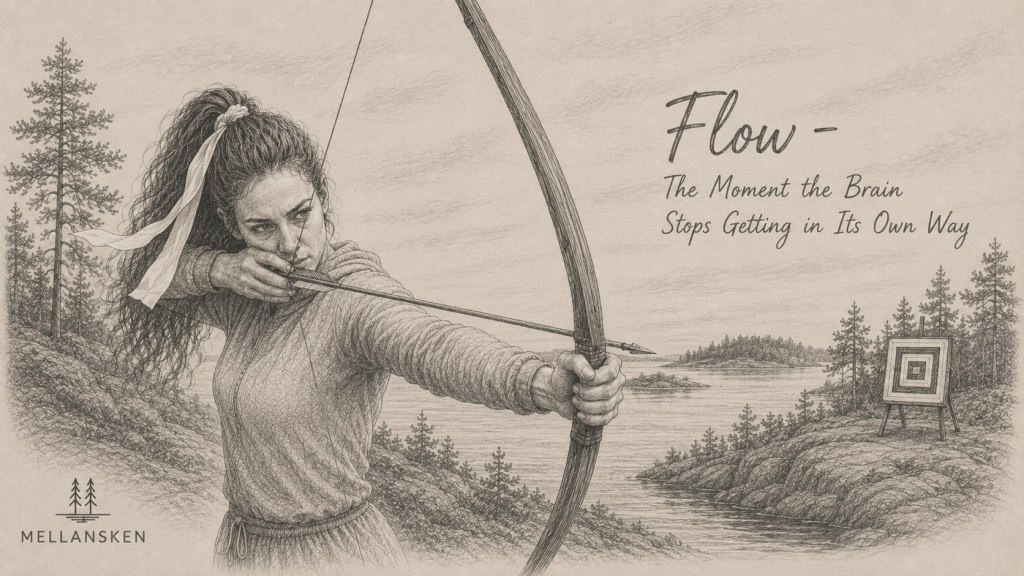
Flow – The Moment the Brain Stops Getting in Its Own Way
Have you ever forgotten yourself?
It may have lasted only a few seconds. You were completely absorbed in what you were doing.
Time disappeared. The outside world became quieter. Your movements felt effortless.
You weren’t thinking about what came next. You were simply doing it.
Most people have experienced moments like these. A pianist playing without looking at the keyboard.
A child building a tower from wooden blocks. A climber moving across a rock face.
A surgeon performing a delicate procedure. An archer releasing an arrow. Different activities.
The same state of mind.
Psychologists call it Flow.
The Discovery of Flow
The concept of Flow was introduced by the Hungarian-American psychologist Mihály Csíkszentmihályi after decades of research.
He interviewed thousands of artists, athletes, scientists, musicians and surgeons.
Despite their different professions, they described remarkably similar experiences.
They weren’t primarily motivated by money. Or praise. Or competition.
They kept returning because they experienced moments in which the activity itself became deeply rewarding.
Csíkszentmihályi called this state Flow because people often described it as being carried effortlessly by a current.
What Happens Inside the Brain?
Flow isn’t magic. Nor is it mystical.
It is a measurable state of brain function.
Brain imaging studies suggest that during Flow, activity in parts of the prefrontal cortex temporarily decreases.
This phenomenon is known as transient hypofrontality.
The prefrontal cortex is responsible for many conscious processes:
- self-monitoring
- worrying
- planning
- judging
- analysing
These abilities are incredibly valuable. But during highly practised movements, they can also become obstacles.
The brain temporarily reduces this internal commentary. Not because thinking becomes impossible.
But because constant evaluation is no longer necessary.
The Brain Doesn’t Become Less Intelligent
This is one of the biggest misunderstandings. During Flow, the brain is not „switching off.“
In fact, many neural networks become even more efficiently coordinated.
The analytical mind becomes quieter. The motor system becomes more fluent. Vision becomes more focused.
Attention narrows naturally onto what matters. Instead of fighting each other, different brain systems begin working together.
Why Beginners Rarely Experience Flow
Many people expect Flow during their first lesson. Unfortunately, the brain has other plans.
Before movements become automatic, they must first become familiar. In the beginning, the prefrontal cortex is busy.
Every movement requires conscious attention.
Where do I place my feet? How do I hold the bow? Where should my shoulders be? All of this is perfectly normal.
Flow cannot replace learning.
Learning creates the conditions for Flow.
The Hidden Teacher: The Cerebellum
One of the most remarkable structures involved in movement is the cerebellum.
Although it contains only about ten percent of the brain’s volume, it houses more than half of all its neurons. The cerebellum constantly compares intention with reality.
Did the movement unfold as expected? Was the timing correct? Was balance maintained? Were corrections needed?
It performs these calculations automatically. Without words. Without conscious awareness. Every arrow gives the cerebellum another opportunity to refine the movement.
Thousands of invisible adjustments slowly become one beautiful shot.
Why Feedback Is More Important Than Success
The brain learns from differences.
Not perfection.
If every arrow landed exactly where expected, there would be very little to improve.
Ironically, small errors provide the richest information.
The brain constantly asks: What happened? How was this shot different? What should I change next time?
This process is known as error-based learning.
Without it, improvement would almost stop. This is why mistakes are not the opposite of learning.
They are one of its essential ingredients.
Dopamine: More Than the „Reward Chemical“
Dopamine is often described as the brain’s reward molecule. That description is incomplete.
Its more important role is helping the brain decide:
This experience matters.
When something unexpected happens…
when curiosity is awakened…
when progress is noticed…
dopamine helps strengthen the neural pathways involved.
It encourages the brain to repeat behaviours worth remembering.
Learning and motivation therefore grow together.
Why Instinctive Archery Is Such a Powerful Teacher
Traditional system target archery often directs attention toward equipment.
Sights. Measurements. Mechanical precision.
Instinctive archery removes many of these layers.
It asks a simpler question. Can you trust what your brain has already learned?
That simplicity creates unusually clear communication between action and feedback.
Every arrow tells a story. Not only about technique. But about attention.
Breathing. Balance. Emotion.
And trust.
Flow Cannot Be Forced
This may be the most important lesson. Many people try to achieve Flow. The harder they try…
the further it moves away. Flow is not produced by effort alone. It emerges when preparation meets presence.
The brain has practised enough. The body has repeated enough. Attention becomes quiet enough.
Only then does Flow quietly appear. Like a visitor. Never commanded.
Only welcomed.
Between the Islands
The sea never hurries.
Yet it shapes the granite.
Mellansken in One Sentence
Flow is not the absence of thought. It is the moment experience becomes wiser than conscious control.