
Why Can Humans Throw Instinctively?
A Skill Older Than the Bow
When people talk about instinctive archery, they usually think of bows, arrows, and targets.
But its true roots reach much further back. Thousands of years further. Long before the first bow was ever built, humans were already something else:
Throwing hunters.
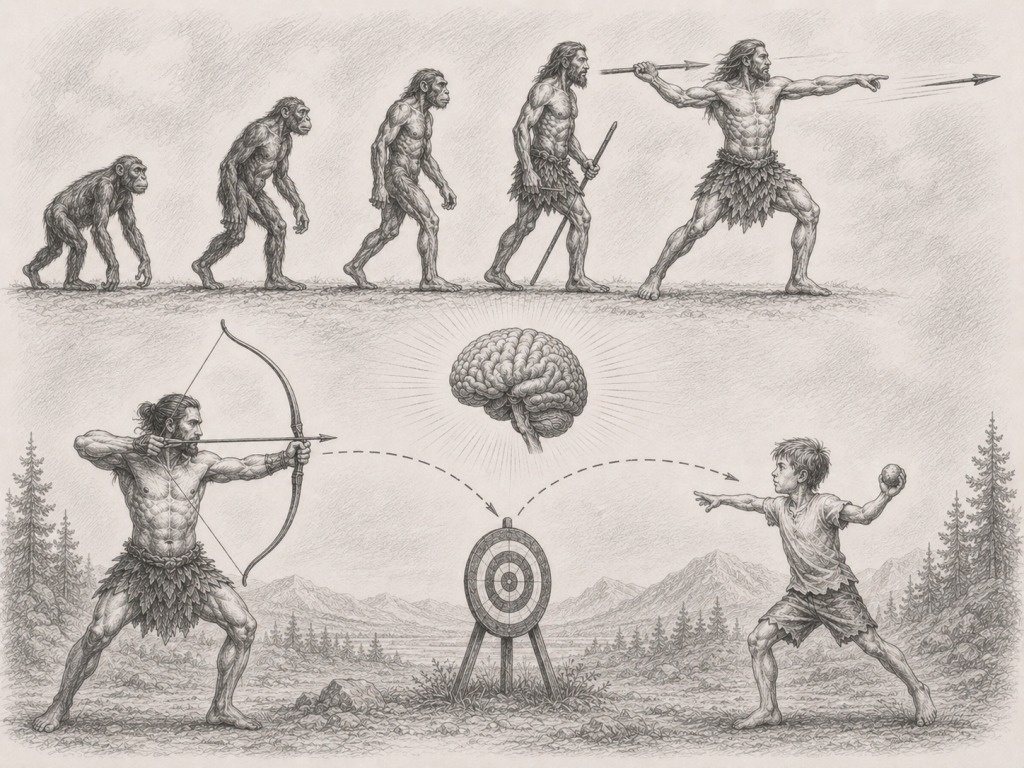
Our ancestors threw stones. Later, they threw spears.
And they did so with a level of precision that is nearly unique in the animal kingdom.
Perhaps the story of instinctive archery does not begin with the bow.
Perhaps it begins with the first stone a human threw at a target.
Humans as Throwing Hunters
When we compare humans with other primates, something interesting becomes apparent.
Chimpanzees are stronger. Gorillas are more powerful. Many animals are faster.
But when it comes to accurate throwing, humans possess an extraordinary ability.
A skilled person can throw a stone, a ball, or a spear with remarkable accuracy.
Even children often develop this skill naturally. No one teaches a child the physics of a ball’s flight.
No one explains trajectories or equations. And yet children learn to throw.
Why?
Because our brains and bodies evolved over countless generations for exactly these kinds of tasks.
Why Chimpanzees Rarely Throw Accurately
Chimpanzees can throw objects. But their throws lack both the accuracy and the speed of a human throw.
The reason is not intelligence. It is anatomy and neurology.
The human shoulder structure allows rotational movements that are ideal for fast and accurate throwing.
In addition, our brain possesses an extraordinary ability: It can predict trajectories.
This combination helped make humans successful throwing hunters.
The Brain Thinks in Trajectories
When you throw a ball, you do not consciously calculate angles, velocity, or distance.
You do not solve equations. You do not consult tables. And yet the ball often lands surprisingly close to the target.
The brain works differently. It uses experience. It recognizes patterns. It generates predictions.
With every repetition, those predictions become more accurate.
That is why we can throw without calculating.
Prediction Rather Than Reaction
Perhaps one of the greatest strengths of the human brain is not seeing what is happening now.
But anticipating what will happen next. A hunter did not throw a spear at the animal he saw in that exact moment.
He had to estimate where the animal would be a moment later. The spear needed time to travel.
The animal continued to move.
Success therefore depended not only on aiming.
But on prediction. We still use this same ability today. When we catch a ball. When we throw a ball.
Or when we follow the flight of an arrow. Interestingly, nobody catches a ball where it is.
We move our hand to where the ball will be.
The brain continuously makes these predictions. Usually without conscious awareness.
Perhaps this ability was one of the decisive advantages of our ancestors.
Not merely perceiving. But anticipating. Not merely reacting.
But predicting.
How Children Learn to Throw
Anyone who watches children play can observe something remarkable.
They throw. Again and again. Stones. Pinecones. Snowballs. Balls.
And with every throw they improve. Not because someone explains the movement.
But because their brain is learning. Every throw provides feedback.
Too far. Too short. Too high. Too low. Too fast. Too slow.
The nervous system uses this information to refine its internal models.
The learning process is remarkably similar to what later happens in instinctive archery.
From Spear to Arrow
Perhaps this is where the connection to instinctive archery becomes visible.
An arrow is not a ball. Nor is it a spear. Yet the brain relies on similar abilities.
It estimates distance. Recognizes size and perspective. Predicts trajectories.
Connects perception with movement. The bow simply extends this ability.
It does not replace it. The arrow is therefore less a technical invention and more an
extension of a capability that already existed within us.
Why We Can Judge Distance Intuitively
For a throwing hunter, distance was never a minor detail. It could determine success or failure.
Too short. Too far. A complete miss. Every mistake had consequences.
Over countless generations, the brain developed an extraordinary ability:
Spatial perception.
We compare size. Perspective. Movement. Distance.
Often without any conscious awareness. We still use this ability today.
When reaching for a cup. When catching a ball.
And when practicing instinctive archery.
An Ancient Ability in a Modern World
This also explains why so many people are fascinated by instinctive archery.
It relies on abilities deeply rooted in our evolutionary history. Abilities far older than any modern sport.
When we shoot an arrow, we use the same fundamental tools our ancestors relied upon:
Perception. Experience. Movement. Prediction. Learning.
Of course, we live in a very different world today.
But our brain still carries traces of that past.
What Role Did Hunting Play in Human Development?
More Than Food
When we think about hunting today, we usually think about food.
Meat. Survival. Tools and weapons.
But hunting likely shaped humanity far beyond what ended up over a fire.
It influenced the way we perceive. The way we think. The way we learn.
The way we cooperate.
Perhaps hunting even helped shape part of what makes us human.
Humans Were Not Powerful Predators
Compared with classic predators, something becomes obvious.
Humans have no sharp claws. No large fangs. No extraordinary speed.
A leopard is faster. A bear is stronger. A wolf is better armed.
Humans did not succeed through strength.
They succeeded through something else:
Their brain.
The Art of Persistence Hunting
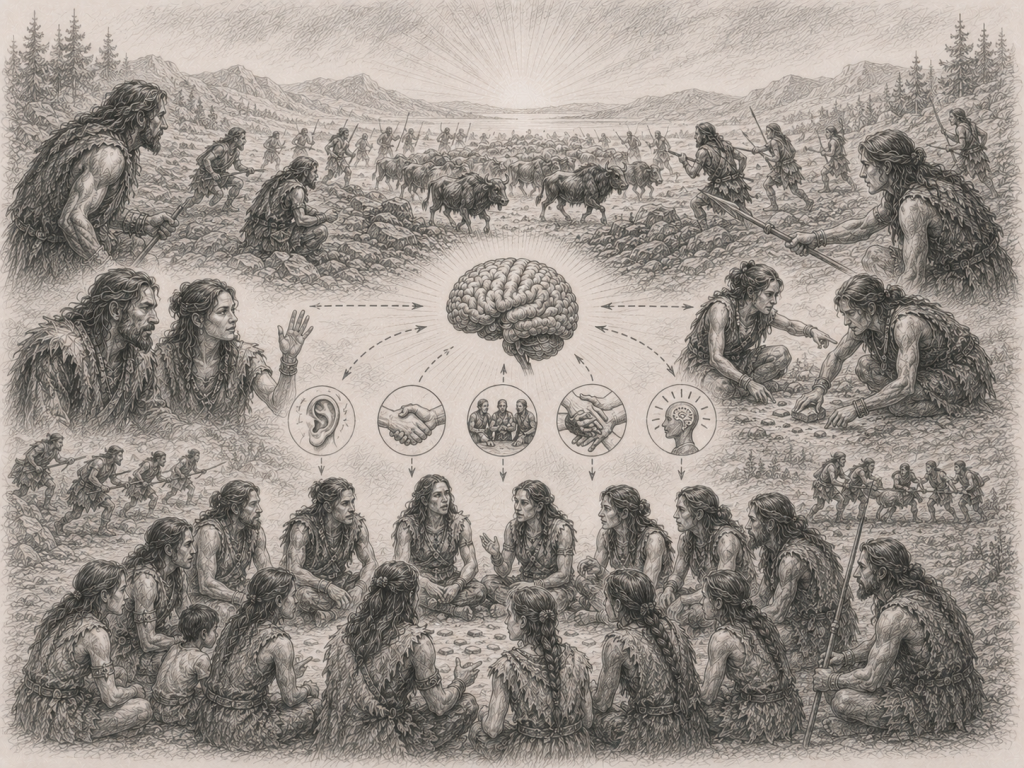
Many researchers believe that persistence hunting played an important role in human evolution.
In persistence hunting, a hunter follows an animal not for minutes.
But for hours. Sometimes days. Sometimes across many miles. The goal was not to be faster.
The goal was to endure longer. While many animals struggle in extreme heat, humans possess a remarkable advantage:
We can travel long distances while regulating body temperature very efficiently.
As a result, hunting became less of a sprint.
And more of a problem to be solved.
Perception as a Survival Advantage
A hunter had to remain attentive. Recognize tracks. Notice changes. Detect movement. Interpret sounds.
Read the wind. Understand the environment. Anyone who failed to pay attention lost the trail.
Perhaps this is one reason why our perceptual abilities became so highly developed.
Not because perception was interesting.
But because it determined success or failure.
Spatial Thinking
Hunting involved more than simply following an animal. The hunter had to estimate distances.
Understand terrain. Recognize potential escape routes. He had to imagine where an animal might be
even when it was no longer visible.
The brain learned to build spatial models of the environment.
A skill we still use today. While driving. Throwing. Hiking.
Practicing instinctive archery.
And in countless other activities of daily life.
Planning Rather Than Instinct
Humans are often described as instinctive hunters. In reality, humans were primarily planning hunters.
They had to think ahead. Evaluate possibilities. Assess risks. Develop strategies.
Perhaps this is one of the greatest differences between humans and many other predators.
Humans did not simply react to their environment.
They began to think about it.
The Power of Cooperation
A single human was rarely the most dangerous creature in the landscape.
A group of humans was.
Hunting encouraged communication. Trust. Cooperation. Shared decision-making.
Successful hunting often required working together.
Perhaps it is no coincidence that social skills became one of the greatest strengths of our species.
Learning Became Essential for Survival
Every mistake had consequences. A wrong decision. An overlooked track. A poor judgment.
Hunting provided constant feedback. The brain learned. Adapted. Improved its internal models.
Perhaps this helps explain why humans developed such extraordinary learning abilities.
Learning was not a luxury.
Learning was survival.
A Skill That Remains With Us Today
The world has changed. Most people no longer need to hunt in order to survive.
Yet our brain still carries many of these abilities. Perception. Spatial thinking. Planning.
Cooperation. Learning from experience.
These same abilities reappear in instinctive archery.
Perhaps that is why it feels so natural to so many people.
Not because they have ever hunted.
But because they are descendants of people who did.
What Does This Have to Do with Instinctive Archery?
Perhaps instinctive archery is more than a shooting technique.
It draws upon abilities deeply rooted in our evolutionary history.
Perception. Distance estimation. Spatial thinking. Learning through experience.
Trust in learned movement. Compared to this story, the bow is a relatively modern invention.
The abilities behind it are not. Perhaps this is why instinctive archery continues to fascinate us today.
Because it reminds us of something much older than the bow itself.
The abilities that helped shape humanity into what it is today.
Not the strongest predator.
But the most intelligent hunter.