
The First Room Where No One Checks
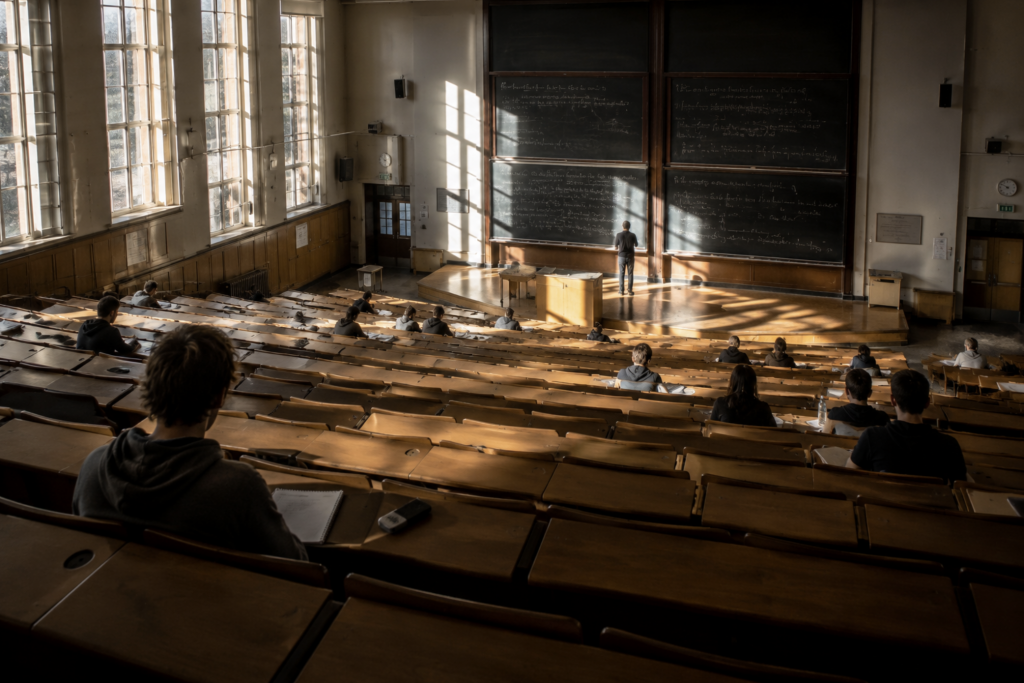
Three hundred seats. Maybe four hundred.
You sit down somewhere in the middle, next to a stranger who will forget your name by Friday.
The professor doesn’t know you exist yet. Might never.
No one takes attendance. No one will call your parents if you don’t show up tomorrow.
For the first time in your life, the room does not need you to be there.
You could leave right now. Walk out, get coffee, never come back.
Nothing would happen. Not today. Not this week.
That silence — the specific silence of nobody watching — is the actual lesson. It always was.
I still remember my first lecture.
I kept looking around, expecting someone to tell us what to do next.
Nobody did.
That was the lesson.
Freedom Arrives Before Discipline Does
Every structure that shaped you until now assumed you needed watching.
A parent checked your homework. A teacher tracked your name in a register. A school bell decided when you moved.
University removes all of it at once, and calls the removal an achievement.
No one warns you that freedom, on its first morning, feels almost exactly like abandonment.
It takes most people a semester, sometimes a year, to understand: the empty seat beside you every Monday isn’t proof no one cares.
It’s proof that, for the first time, the caring has been handed entirely to you.
Freedom begins the day no one checks whether you came.
Learning to Teach Yourself, in Private
School taught you beside twenty-six others, all struggling in view of each other. That struggle was public, almost comforting.
University often teaches you alone — in a library carrel at midnight, in the specific loneliness of a textbook chapter nobody else in your life has read.
No one will notice if you understood the lecture. Only you will notice, three weeks later, when the exam arrives and either you can, or you can’t.
That delay — between not-knowing and consequence — is new. Nothing before this taught you to sit inside it.
The First Subject You Actually Chose
A child doesn’t choose fractions. A teenager doesn’t choose history class.
At university, often for the first time, you chase down a single narrow question — Byzantine trade routes, the physics of turbulence, the syntax of a dead language — because you wanted to know, not because a curriculum required it.
That choosing changes the learning itself.
Knowledge you were assigned sits differently in the mind than knowledge you went looking for.
One is memorized. The other becomes, quietly, part of who you are.
What Nobody Tells You About the Silence
Years later, people rarely describe university by its lectures.
They describe the particular ache of an empty dorm room on a Sunday. The specific freedom of realizing no one was coming to check whether they’d wasted the day.
Some wasted many days. Some didn’t.
The ones who eventually learned something real usually say the same thing: it wasn’t the professors. It was the moment they stopped needing someone to make them care.
That moment cannot be taught by a parent, a teacher, or a coach.
It can only be arrived at, alone, in a room no one is watching.
Why Mellansken Exists
Nobody stands over a student’s shoulder counting arrows.
No bell decides when practice ends. No one checks whether you came back next week because you wanted to, or because someone made you.
That absence of pressure is not an oversight. It is the entire point.
Instinctive archery, like university, only works once the student decides, privately, that this matters — with no one left to convince but themselves.
Between the Islands
No one
can cross
for you.
Mellansken in One Sentence
The first freedom no one prepares you for is the freedom no one is watching to see if you use.
Key Takeaways
- University marks the first major shift from externally enforced structure to self-directed responsibility.
- This freedom often feels like abandonment before it feels like autonomy — a documented adjustment period, not a personal failing.
- Learning shifts from public, shared struggle (school) to private, self-monitored effort (university).
- Self-chosen knowledge is processed and retained differently than assigned material — autonomy changes the learning itself.
- The defining lesson of university is rarely a subject. It’s the moment a student stops needing to be made to care.
Science Behind This Article
Research on Self-Determination Theory (Edward Deci & Richard Ryan) shows that autonomous motivation — acting because something matters to you, not because you’re being monitored — produces deeper, more durable learning than controlled motivation. Studies on the transition to higher education consistently describe a sharp drop in external structure, paired with a measurable adjustment period, often termed the „autonomy gap,“ as students shift from externally regulated to self-regulated learning. Carol Dweck’s research on mindset further suggests that this shift is where a growth orientation toward learning — pursuing understanding for its own sake — either takes root or fails to, often for the first time in a young person’s life.