
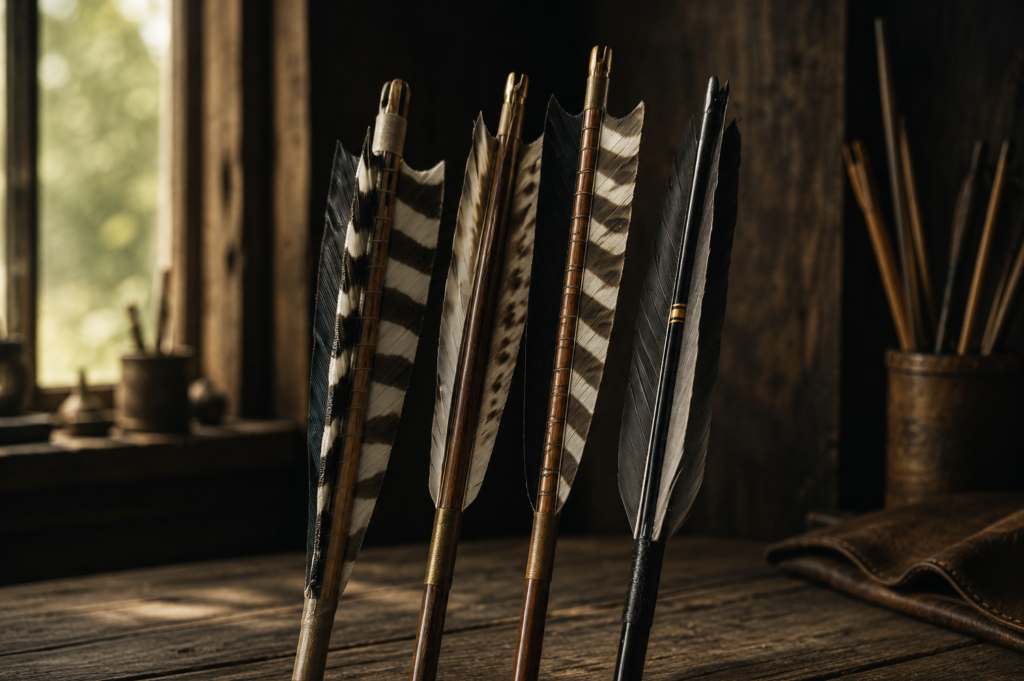
The Arrow Has No Opinion About You
He’d missed the same shot four times with the same arrow, and by the fourth miss, he was blaming the arrow.
„This one’s bent,“ he said, turning it slowly between his fingers, searching for a flaw he wanted more than he expected to find. „It never flies straight.“
His coach took it without a word. Set it on the same string. Drew to the same reference point. Allowed the string to leave.
The arrow flew cleanly into the gold.
He handed it back. Didn’t say „See.“ Didn’t need to.
The boy looked at the arrow as though it had betrayed him twice now — once by missing, and once by refusing to remain the excuse he wanted.
„It was never the arrow,“ the coach said quietly. „It only tells you what already happened. It has no opinion about who you’d rather it was.“
An Arrow Cannot Be Argued With
A bow has character. Grain, memory, a personality shaped by the tree it once was — you learn a bow the way you learn a person, slowly, patiently, discovering over time what it asks from you.
An arrow has none of that. It has only physics, and physics has never negotiated with anyone.
Whatever the body actually did in that half-second — the grip, the breathing, the shoulder that never quite opened — the arrow reports it exactly. Without commentary. Without kindness. Without cruelty. Only truth.
The bow teaches over years. The arrow answers in a single second.
The Arrow Doesn’t Remember Yesterday
This may be the quietest lesson every archer eventually learns.
The temptation is almost irresistible: yesterday’s miss quietly follows us to today’s shooting line. Before the bow is even raised, part of the mind is already expecting another failure.
The arrow knows nothing about any of this. No memory, no disappointment, no expectation. Nocked and drawn, it asks only one question — what is true, right now?
An arrow that missed nine times yesterday will fly perfectly on the tenth if the body finally tells a different story. It asks for no apology. It demands no repayment. It holds no grudge from the nine before it. Very few teachers in life offer that kind of clean forgetting. The arrow offers it every single time, by default, because it was never capable of anything else.
We rarely arrive as empty as the arrow does. We carry yesterday’s misses, old successes, opinions about ourselves, stories repeated so often they begin to feel like facts. Reality carries none of them. It is interested only in what actually happened — not in what we hoped happened, not in what usually happens. Only this time.
Where the Blame Quietly Wants to Go
There is something deeply human about looking away from ourselves the moment something goes wrong. The wind. The light. The equipment. This one’s bent.
Sometimes the equipment really is at fault — arrows do warp, fletching does fail. But far more often, blaming the arrow simply feels kinder than asking the harder question: what did my body actually do?
The arrow makes a terrible scapegoat — not because it argues, but because it refuses to. Pick up the same „faulty“ arrow, change nothing but the body behind it, and the answer changes immediately. That correction — quiet, wordless, undeniable — is often more convincing than any explanation a coach could offer in its place.
What the Arrow Actually Measures
It is tempting to think the arrow measures skill. Mostly, it measures something closer to honesty — not whether you’re a good archer, not whether you were yesterday, not whether you hope to become one tomorrow. Only whether, in this single moment, your body told the truth about its tension, its alignment, its readiness.
A skilled archer having an off day and a beginner can both produce the same wide shot. The arrow has no interest in reputation. It recognizes neither confidence nor embarrassment. It simply reports — one moment, one body, one truth.
That is a strangely rare kind of feedback to receive, in a life mostly built from opinions, reputations, and the stories we tell about ourselves.
Why Mellansken Exists
Many students arrive hoping to hear that they’re improving — reassurance, encouragement, some version of the story they’d like to be true.
The arrow offers something quieter, and eventually more valuable: an answer with no interest in encouraging you, disappointing you, or protecting you. Not cruel. Simply uninterested in anything except what actually occurred.
Learning to receive that kind of answer without flinching, without blaming, without needing it softer than it is — that may be one of the quieter, deeper things instinctive archery eventually teaches everyone who stays with it long enough.
Between the Islands
The current
does not remember
which way you drifted
yesterday.
It only asks
where you are
now.
Mellansken in One Sentence
The arrow has no opinion about who you were yesterday — only about what your body did, honestly, this one time.
Key Takeaways
- Unlike a bow, which reflects character and relationship over time, an arrow reflects a single, immediate truth with no memory or bias.
- Blaming equipment for a miss often feels kinder than honestly assessing what the body actually did — but it’s rarely accurate.
- An arrow carries no memory of previous misses; each shot is judged entirely on its own, offering a rare form of clean feedback.
- What an arrow measures is closer to honesty in the moment than skill in general — reputation and expectation don’t influence its flight.
- Learning to receive unflinching, neutral feedback — without needing it softened — is a distinct and valuable skill in itself.
Science Behind This Article
Research on feedback and skill acquisition supports what every archer eventually learns from the arrow itself. Studies on knowledge of results, a foundational concept from Richard Schmidt’s work on motor learning, show that immediate, accurate, and unembellished feedback produces more reliable skill correction than delayed or socially filtered feedback. Carol Dweck’s research on mindset further suggests that neutral, non-judgmental information about performance — rather than praise or blame — supports a healthier, more resilient relationship with mistakes. Research on attribution bias, building on Bernard Weiner’s work, additionally explains the common tendency to attribute failure to external factors (the equipment, the conditions) rather than internal, correctable causes — precisely the impulse the arrow, quietly and without exception, refuses to indulge.