
The Bow I Rarely Pick Up
Two bows lean in the corner of my workshop, and I know exactly which one I’ll reach for tonight.
It won’t be either of these.
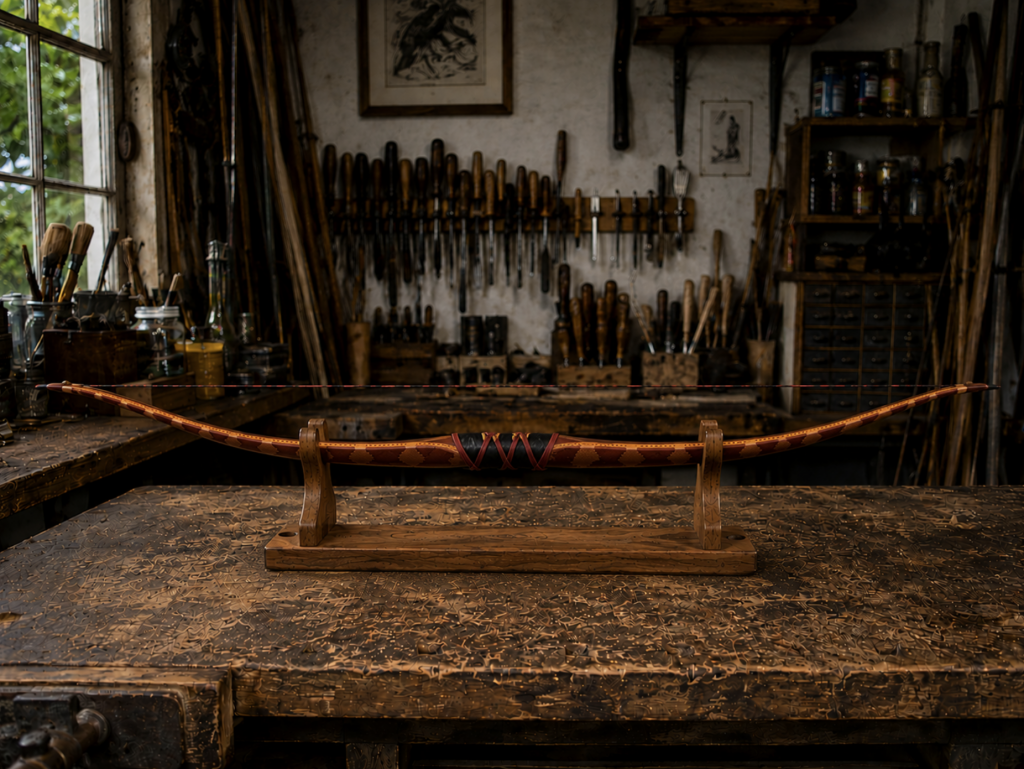
Both are American yew. Both backed with rattlesnake skin, the diamond pattern softened by years of oil and handling. Both tipped in horn, the way bowyers finished them long before synthetic materials promised consistency instead of character.
By any honest measure, they are the finest bows I own.
Not because they’re rare.
Not because they’re beautiful.
Because they refuse to hide anything from me.
I shoot them rarely.
Not because they shoot worse.
They don’t.
Not because they’ve ever failed me.
They haven’t.
Not once.
I shoot them rarely because somewhere, over more than twenty-five years, my hands quietly learned a different habit — the smoother draw of modern limbs, the comforting predictability of materials designed to forgive small mistakes instead of revealing them.
Habit, once it settles into the body, asks very little permission to stay.
Knowing Better Was Never the Same as Doing Better
This is, I think, the part almost nobody likes to admit.
Understanding a truth has surprisingly little influence over whether we actually live by it.
I can explain exactly why a single-stave bow is the more honest teacher.
I can show a student how a forgiving modern limb quietly absorbs mistakes that solid wood faithfully reports back.
None of that knowledge has persuaded my own hand to reach into that corner more than a handful of evenings this year.
Habit never argues.
It never tries to convince you.
It simply survives your good intentions…
one ordinary evening at a time…
until eventually you stop noticing that it’s winning.
The Comfortable Tool Doesn’t Lie Either
I want to be fair.
This isn’t a story about good bows and bad bows.
My modern bows have never lied to me.
They still tell the truth.
They simply don’t tell all of it.
They were designed to forgive.
To smooth away tiny inconsistencies instead of announcing them.
That isn’t poor design.
It is excellent design.
And perhaps that is exactly where the danger begins.
A tool considerate enough to stop asking difficult questions eventually allows us to stop answering them.
The old bow never became harsher.
It simply remained unwilling to protect me from myself.
The Things We Respect Most
There is a particular kind of contradiction hidden inside experience.
Almost every accomplished archer I know owns at least one bow they respect more than they actually shoot.
A bow they would defend without hesitation in conversation…
and quietly leave behind when nobody is watching.
I don’t think this belongs only to archery.
Most people carry something like that.
A musical instrument.
A language they once loved.
A trail through the forest they always meant to walk again.
A conversation postponed so many times that it quietly became part of the furniture of life.
Respect, it turns out, is not always enough to bring us back.
What Changes When I Finally Pick It Up
The evenings I finally reach for the rattlesnake bow are rarely comfortable.
The draw asks for something my hands have slowly forgotten how to give without thinking.
The first arrows almost always drift.
Not because the bow changed.
Because I did.
Then, somewhere around the fifth or sixth arrow, something familiar returns.
The body stops correcting.
It starts listening.
The shot doesn’t become better.
It becomes truer.
There is a particular honesty in a tool that has never once been interested in making me feel successful.
Only truthful.
I always tell myself I’ll shoot it more often after that.
I rarely do.
That contradiction may be the most honest sentence in this entire article.
Why Mellansken Exists
People sometimes imagine that experience eventually removes these contradictions.
I have never found that to be true.
Experience simply makes them easier to recognise.
I don’t tell this story because I’ve solved it.
I tell it because I haven’t.
Pretending the teacher has already overcome everything he teaches would be its own quiet dishonesty.
Perhaps the most valuable thing a teacher can offer isn’t certainty.
Perhaps it is permission to admit that learning never really stopped.
Not even after twenty-five years.
Between the Islands
The old boat
still waits.
Some mornings…
I choose
the newer one
anyway.
Mellansken in One Sentence
The tool that tells us the deepest truth is rarely the one habit quietly teaches us to reach for.
Key Takeaways
- Understanding why something is better rarely, on its own, changes what we actually reach for — knowledge and habit operate on different systems entirely.
- A tool or practice that forgives small mistakes isn’t dishonest; it simply asks less of us, which over time can quietly become its own form of avoidance.
- Nearly everyone carries at least one thing — a tool, a skill, a relationship — they respect more than they actively return to.
- Renewed contact with a more demanding practice often feels worse before it feels truer; the discomfort is part of what makes it honest.
- Experience doesn’t remove this contradiction. It only makes it easier to notice — and admitting that, openly, is itself a form of teaching.
Science Behind This Article
Research on habit formation explains why understanding rarely overrides ingrained behavior. Wendy Wood’s research on habit shows that once a behavior becomes automatic, it is driven by contextual cues rather than conscious intention or even explicit values — precisely why „knowing better“ so often fails to change what a person actually reaches for. Studies on cognitive dissonance, building on Leon Festinger’s foundational work, further describe how people routinely hold contradictory beliefs and actions simultaneously, often resolving the discomfort not by changing behavior, but by quietly minimizing the importance of the contradiction. Richard Thaler and Cass Sunstein’s research on choice architecture additionally shows that the path of least resistance reliably wins out over the objectively better option, even among experts who fully understand the difference — a pattern this bow, leaning in its corner, has been patiently demonstrating for years.