
One Arrow, No Second Chance: What Roving Really Teaches
I remember the first time I shot without a target line. No mat, no fixed distance, no second arrow waiting in my hand. Just a rotten tree stump forty steps into the forest, chosen in the moment it caught my eye. I drew, I allowed the shot, and the arrow was gone before I had time to decide whether I’d aimed correctly. That is roving — and it taught me more about archery than any target range ever did.
What Roving Actually Is
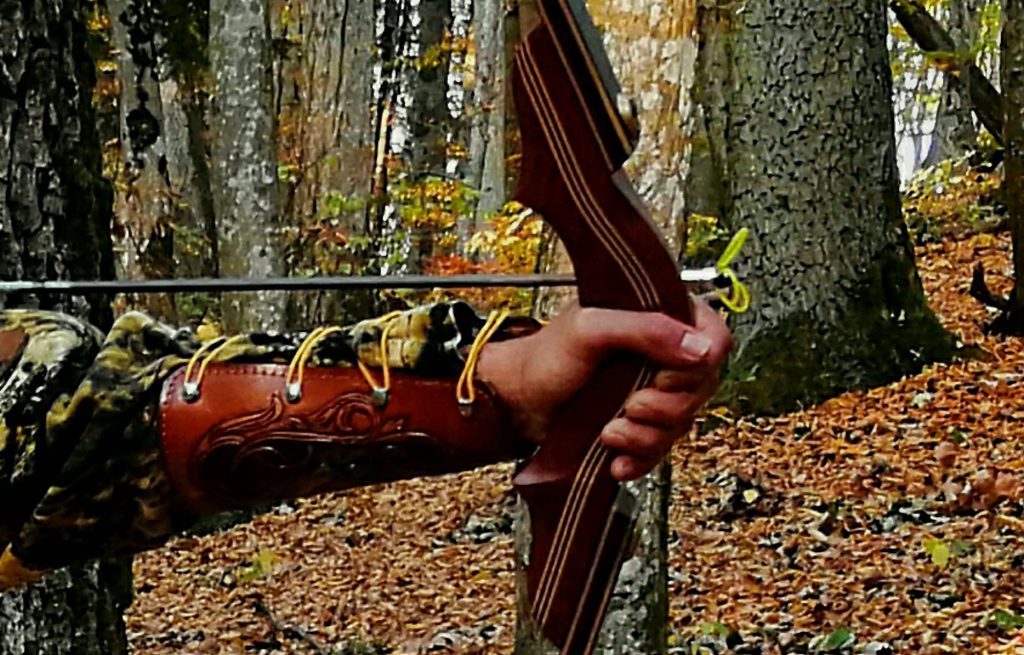
Roving — sometimes called roving the butts — is archery without a fixed position. I walk through forest, meadow, or uneven hillside, and I choose a target as I go: a stump, a tuft of grass, a fallen leaf still clinging to a branch. I shoot once. There is no return shot, no correction, no do-over. The decision is made the moment I release the arrow from the string — it isn’t a rehearsal, it’s a commitment.
I’ve come to think roving isn’t training for the hit at all. It’s training for the decision.
Where This Comes From
The word itself surfaces in 17th-century England, tied to the Royal Company of Archers, founded in 1676, whose annual contest for the Edinburgh Arrow was held on open ground at Leith Links rather than a fixed range. A century later, the Royal Toxophilite Society turned roving into something closer to a shared ritual — walking through parks and countryside, shooting at whatever presented itself, and gathering afterward. Roger Ascham, writing in the 16th century, put it more plainly than I ever could: the true archer is made in the field, not at the stand.
What It Actually Trains
Without a marked distance, my body has to feel it instead of measure it. My eyes take in information, but the decision comes from somewhere older than calculation — from repetition in real, uneven terrain, not from a number.
It also breaks a habit I see constantly on a fixed range: target fixation. When the target is small, half-hidden, or moving in the wind, hitting stops being the point. What matters is whether I made the right decision in that moment. I can’t control whether the arrow lands — I can only control how I act before I let it go.
And it forces a kind of terrain literacy that no flat range ever demands: wind direction, uneven footing, shifting light, sightlines through branches. This is the root from which 3D archery and archery golf both grew — modern, structured versions of something that was never meant to be structured at all.
Above all, roving asks for presence, not performance. Every shot is new. There’s no routine to fall back on, no automation to coast through. I either meet the moment fully, or the shot fails before it begins.
Between the Islands
Out here in the archipelago, roving feels less like a technique and more like the natural way to move. I walk a shoreline path, and a piece of driftwood catches my eye before I’ve even decided to look for a target. There is no mat underfoot, only moss and granite. No fixed distance, only the distance that happens to exist between me and that piece of wood in that moment. I draw, I open the back, I allow the shot — and the arrow is already gone, carried off toward the trees the way the wind carries everything else out here. Nothing about the islands is fixed either. The water moves the shoreline a little every season. Roving simply asks me to move with it, rather than against it.
Mellansken in One Sentence
Roving isn’t a method for hitting more often — it’s a practice in trusting a single decision, made once, without the safety of a second arrow.
Key Takeaways
- Roving means shooting once, at an unmeasured target, with no return shot and no correction.
- It trains distance perception through the body, not through calculation.
- It reduces target fixation by making the decision — not the hit — the point.
- It builds real terrain competence: wind, uneven ground, light, sightlines.
- It asks for full presence in each individual shot, since no routine carries it.
- In Sweden, roving is generally permitted as recreational practice under Allemansrätten, provided it stays clear of hunting, doesn’t disturb others or the environment, and keeps roughly 150–200 meters from homes.
Science Behind This Article
Roving’s documented history reaches back to the Royal Company of Archers (1676) and their Edinburgh Arrow competition held at Leith Links, and to the Royal Toxophilite Society (founded 1781), which practiced roving as a social tradition through parks and open country. Roger Ascham’s Toxophilus (1545) is among the earliest written sources distinguishing field-based judgment from fixed-range repetition. Contemporary derivatives include 3D archery and archery golf, both structured adaptations of the same unmarked-distance principle.