
Sometimes the people who change us never discover that they did.
What the Water Knows
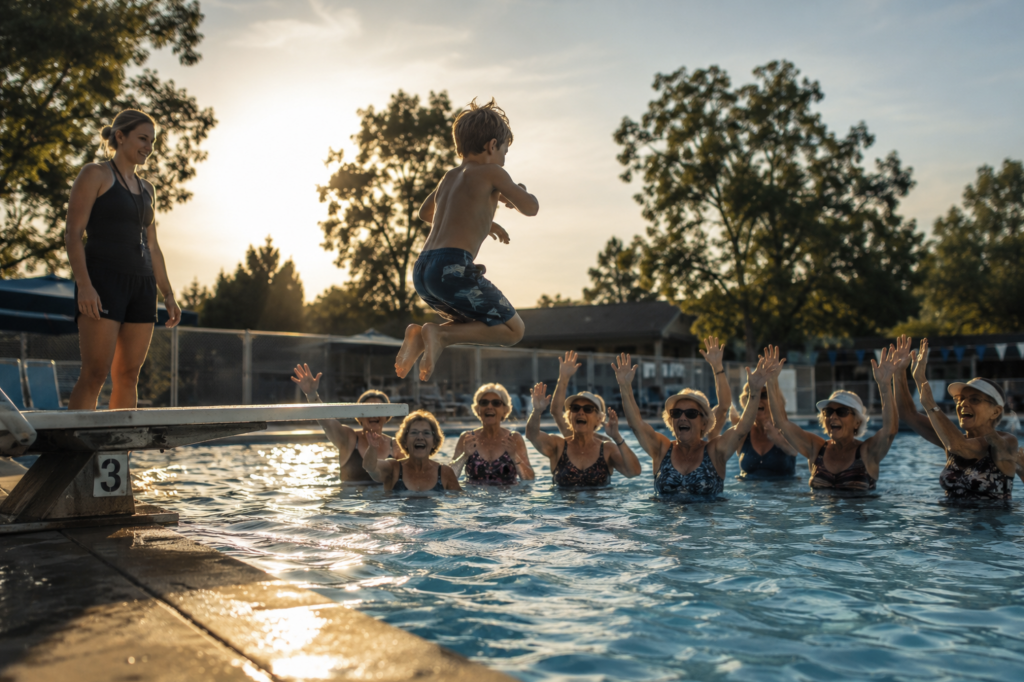
He stood on the edge of the block for almost four minutes.
Toes curled over the edge. Arms crossed over his chest like he was cold, though the sun was already warm on the concrete and the whole outdoor pool smelled of sunscreen and cut grass.
Below him, the water was that flat, chlorinated blue that outdoor pools always are in early summer — no depth to read, no bottom to trust, just a surface that looked, from up here, exactly like something that could swallow him.
His swim teacher stood at the edge, patient, saying the things swim teachers say. „You can do this. I’ve watched you do this in the shallow end forty times.“ He nodded. He didn’t move.
Then, from the next lane over, the water aerobics class noticed. Fifteen women, most of them old enough to be his grandmother, sun hats bobbing, treading water in a loose circle, paused mid-exercise and turned to watch.
One of them started it. „Spring! Spring! Spring!“ — Jump! Jump! Jump! — and within seconds all fifteen took it up, laughing, splashing, chanting like it was the most important thing that would happen at the pool all summer. Which, for about six seconds, it was.
The boy looked at them. Fifteen strangers in swim caps, utterly certain he could do this.
He looked at the water.
He jumped.
He came up laughing so hard he swallowed half a mouthful, fists in the air, and the fifteen women cheered like he’d won something enormous.
He had.
The Water Never Changed. He Did.
Here is what’s easy to miss: the water was exactly the same water, the whole time. Same temperature. Same depth. Same chlorine-blue that had looked so much like danger four minutes earlier.
Nothing about the pool became safer while he stood on that block.
What changed was entirely inside him — the moment fifteen strangers‘ certainty became briefly, gloriously louder than his own fear.
This is nearly the whole secret of learning anything difficult. The water doesn’t get kinder. The bow doesn’t get lighter. The arrow doesn’t become more forgiving. What changes, every single time, is whether you can still hear your fear over everyone and everything telling you that you’re already capable of this.
You Cannot Push Yourself Into a Jump
Try to force yourself off a diving block through sheer willpower alone, and you’ll often find yourself more frozen, not less — the mind negotiating, recalculating, finding one more reason to wait just a little longer.
The boy didn’t out-think his fear. He didn’t overcome it through effort. Something outside him — fifteen voices, absurd and joyful — became loud enough to let him stop negotiating with himself long enough to simply go.
The same is true, almost exactly, at full draw. The archer who tries to force the release through willpower alone usually collapses into the same hesitation the boy felt on the block — recalculating, waiting for a certainty that will never quite arrive on command. Allowing the string to leave, like allowing yourself to jump, rarely comes from trying harder. It comes from finally being permitted — by someone, by something, sometimes only by yourself — to stop waiting for permission.
Blue, Green, and the Color Nobody Sees From the Block
From up on that starting block, water only has one color: warning. Flat, opaque, uniform blue-grey, with nothing to suggest what’s actually down there.
It’s only from inside the water — after the jump, not before it — that color starts to separate itself. The deep end, dark and blue. The shallower water near the steps, a lighter green. And where the sun cut straight through near the surface, right where he broke through laughing, that pale turquoise that has no real name.
You cannot see any of that from the block. You only ever see it after you’ve jumped. This is precisely why reassurance from the edge — however true, however well-meant — so rarely convinces anyone standing on it. The swim teacher’s calm words weren’t wrong. They just couldn’t do what fifteen delighted strangers, chanting nonsense syllables under sun hats, managed to do in six seconds: make the jump feel less like risk and more like the obvious, inevitable next thing.
What Happened After
He didn’t want to get out of the pool that day. His teacher had to half-coax, half-laugh him toward the steps, still dripping, still grinning at the fifteen women who waved him off like he was leaving for something important.
Weeks later, she took his hand at the edge of the sea.
Real waves this time. Not the flat, held stillness of a pool — water that moved on its own schedule, rose and pulled and pushed regardless of what he wanted from it, salt-heavy and enormous compared to the tidy blue rectangle he’d learned in.
He hesitated, briefly, the way anyone does at the edge of something genuinely wild.
Then he remembered, without anyone needing to remind him, that the water underneath was still just water. That his body still knew what it knew. That the fear on his face was, once again, only ever about the six seconds before — never about the water itself.
He let go of her hand.
He swam out into the swell, laughing, disappearing and reappearing between waves, completely, uncomplicatedly free — the pool’s careful lesson finally spent on something that had never once needed careful lessons at all.
The Body Already Knew How to Float
Nobody taught that boy anything new between the pool and the sea. He already knew how to swim — in a rectangle, on command, forty careful times.
What changed, standing in the surf with waves that answered to no one, is that he finally understood: the water he’d been afraid of and the water that was now lifting and dropping him were the same substance, the same trust, only larger. Panic invents danger that trusting rarely finds — regardless of how big the water gets.
Every archer eventually leaves their own version of the practice pool — the calm range, the known distance, the forgiving target — for something with real waves in it. A live hunt. A public shoot. A moment that answers to no one’s schedule. The lesson doesn’t change size along with the water. It only gets tested by it.
Why Mellansken Exists
Most people don’t need to be taught the technique they’re afraid of. Most people already have it — in the shallow end, in practice, in the hundred times nobody was watching.
What they need, more often, is exactly what those fifteen strangers gave a frightened boy for free: enough certainty, borrowed loudly enough, for just long enough, that jumping finally feels easier than staying on the block. And afterward — enough trust already built that when the water gets bigger, wilder, more real, the same calm simply comes along for the ride.
That is most of what happens here, quietly, session after session — not teaching someone to shoot, but standing close enough, believing loudly enough, that letting the arrow go finally feels lighter than holding on. So that one day, further out, no one needs to hold their hand at all.
Between the Islands
The water
never changed.
Only
the courage
to enter it.
Mellansken in One Sentence
You already know how to float. What you’re usually waiting for isn’t skill — it’s enough noise, from somewhere, to jump anyway.
Key Takeaways
- Fear rarely reflects actual danger or actual ability — the water, the bow, the moment itself usually hasn’t changed; our capacity to act despite fear has.
- Willpower alone often fails to overcome hesitation; borrowed courage — from a person, a group, a coach — frequently succeeds where internal effort does not.
- Much of what we’re afraid to do, we’re already capable of doing — proven, quietly, in shallower, lower-stakes repetitions beforehand.
- Trust built in a controlled setting transfers to larger, wilder, less predictable settings — the pool prepares the sea.
- Learning to allow — a jump, a release, a shot — is less about acquiring new skill and more about permitting skill that already exists.
Science Behind This Article
Research on fear, courage and motor performance supports what that poolside — and later, seaside — moment shows so plainly. Rich Masters‘ Reinvestment Theory demonstrates that conscious, effortful control of an already-learned skill frequently produces hesitation and failure, while trust in automated competence restores fluency. Studies on social facilitation and collective efficacy — building on Albert Bandura’s work — show that a group’s shared, expressed belief can measurably increase an individual’s willingness to attempt a feared action, beyond what private reassurance achieves alone. Research on skill transfer further explains why confidence built in a controlled environment reliably extends to more complex, less predictable ones — not because the harder task became easier, but because the underlying trust had already been proven true once before.