
Fundamentals
What Is Instinctive Archery?
Instinctive archery is a traditional form of archery in which the archer shoots without a sight or other aiming aids. Rather than consciously calculating distances or relying on technical reference points, the archer learns to place the arrow on target through experience, perception, and repeated practice.
The term comes from the English expression “instinctive shooting” and has been historically documented since the 1920s and 1930s.
In this context, instinctive does not mean that archery is an inborn ability. No one is born with the skill to shoot an arrow accurately.
What is meant is a learned instinct. Through countless repetitions, movement patterns, distance judgment, and target perception become so deeply internalized that they happen without conscious thought. Similar to throwing a stone, the archer does not calculate angles or trajectories. The body has learned what to do.
Instinctive archery does not mean learning less. It means learning until thought and action are no longer separate. The arrow does not fly because of magic. It flies because of experience. Through practice. Through trust. And eventually, something emerges that feels natural. Not because it was inborn. But because it has become part of who you are.
What Is the Difference Between Instinctive and Intuitive Archery?
Today, the terms are often used interchangeably, but originally they did not describe the same thing.
The term instinctive archery comes from the English expression “instinctive shooting,” which has been used in traditional archery since the early decades of the twentieth century. It does not refer to an inborn instinct but to a learned one. Through repeated practice, movement patterns, distance judgment, and target perception become so deeply ingrained that they happen without conscious thought.
Intuitive archery, on the other hand, is a more recent term. The word intuition is commonly associated with feeling, insight, or the spontaneous understanding of a situation. For that reason, the term is often used to describe a more emotional or feeling-based approach to archery.
In practice, the two concepts frequently overlap. Many archers who speak about intuitive archery are ultimately describing the same shooting method.
From a historical perspective, however, instinctive archery is the more precise term. It emphasizes that the skill is neither inborn nor based on spontaneous inspiration. It is developed through training, experience, and thousands of repetitions.
In short:
Intuitive describes the feeling.
Instinctive describes the result of practice.
That is why I deliberately use the term instinctive archery at Mellansken Bågskola. Not because it sounds better, but because it describes the original idea more accurately: a craft that becomes second nature through practice.
Is Instinctive Archery Difficult to Learn?
No. Most people can learn the fundamentals of instinctive archery surprisingly quickly. Many beginners are already hitting reliably at short distances during their very first lesson.
The real challenge is not getting the arrow to hit the target. The challenge is repeating the movement often enough for it to become natural.
Instinctive archery is not based on complicated techniques or technical aids. It is based on perception, coordination, and experience. Similar to throwing a ball or catching an object, the body gradually develops a sense of distance, movement, and timing.
How quickly someone progresses depends both on their individual circumstances and on consistent practice.
One of the beautiful things about instinctive archery is that you do not have to be perfect to enjoy it. Many people discover a special appeal in the simplicity of the bow, the focus on the present moment, and the continuous learning process.
Instinctive archery does not mean learning less. It means learning until thought and action are no longer separate. What begins as conscious practice gradually becomes natural.
Not through magic.
But through experience, practice, and trust.
Can Anyone Learn Instinctive Archery?
Yes. Most people can learn instinctive archery.
It does not require special talent or exceptional physical fitness. What matters are practice, patience, and a willingness to learn.
The body learns with every repetition. What initially feels unfamiliar becomes natural over time. Not because you were born with it. But because you learn it step by step.
Do I Need to Be Athletic or Particularly Strong?
No. Neither exceptional fitness nor great physical strength is required to begin instinctive archery.
More important than strength are sound technique and an appropriate draw weight. That is why beginners at Mellansken start with bows that match their individual needs and abilities. People of all ages and athletic backgrounds can learn instinctive archery.
Why Do Instinctive Archers Shoot Without a Sight?
Because instinctive archery relies on experience rather than technical aiming aids. Through regular practice, the archer learns to perceive distances and target images naturally, without the need for a sight.
The focus remains on the target — not on the equipment.
Is Instinctive Archery Safe?
Yes. Instinctive archery is a safe sport when the basic safety rules are followed.
These include responsible bow handling, clear shooting procedures, and a safe shooting direction. That is why safety rules are an essential part of every course.
Is Instinctive Archery a Sport or More of a Leisure Activity?
Both. Instinctive archery can be practiced as a sport, but it can also be enjoyed as a relaxing outdoor activity.
Many people appreciate the combination of movement, concentration, and the unique sense of freedom that comes from shooting a traditional bow.
What Makes Instinctive Archery Different from Olympic Archery?
The biggest difference lies in the equipment and the shooting method. Olympic archery uses modern target bows equipped with sights and other technical aids.
Instinctive archery, by contrast, is usually practiced with traditional bows without sights. The focus is on a natural shooting motion and trust in one’s own perception.
Why Has Archery Fascinated People for Thousands of Years?
The bow is one of humanity’s oldest tools. For thousands of years it was used for hunting, protection, and competition.
Even today, people are captivated by the combination of concentration, movement, and precision. At the same time, archery offers a rare moment of stillness in an often hectic world.
Shooting Technique
The Stance
The Foundation of the Shot
Every arrow begins long before the string leaves the fingers. It begins where your feet meet the ground.
Many archers look for solutions in their hands.
They adjust their grip. They change their draw. They change their Reference Point.
Yet the cause often lies much deeper.
In the stance.
The ground is the archer’s first teacher. It immediately reveals whether we are standing calmly or working against ourselves. Sometimes you see archers in the most remarkable positions.
They lunge forward. They lean sideways. They twist their bodies. And then attempt to execute a calm shot.
But the bow does not ask for acrobatics. It asks for stability. Before every good shot, there is therefore a simple question:
Are you standing securely and comfortably?
If the answer is no, the shot already begins with a disadvantage. That is why, at Mellansken, we always look first for the simplest stance. The calmest stance. The stance in which the body neither has to fight nor compensate.
The Swedes have a beautiful word for this:
lagom.
Not too much.
Not too little.
Just right.
A good stance often feels surprisingly unremarkable. The feet stand roughly shoulder-width apart.
The weight rests evenly and quietly. The body remains upright and relaxed. Nothing needs to be held.
Nothing needs to be forced. You simply stand there.
Calm. Stable. Present.
Like a rock between the skerries.
From the outside, it may appear insignificant. Yet this is where the foundation for everything that follows is created. A calm stance allows a calm draw. A calm draw allows a calm shot. And a calm shot allows the arrow to find its way.
Sometimes terrain, obstacles, or circumstances require a different position.
Then we adapt. We kneel. We open our stance. We change our position. Yet the goal remains the same:
As much stability as necessary. As little tension as possible. Because the best stance is not the most spectacular one.
The best stance is the one you barely notice throughout the shot.
It carries you. Quietly. Unobtrusively. And that is precisely why it is the foundation of the shot.
The Bow Hand
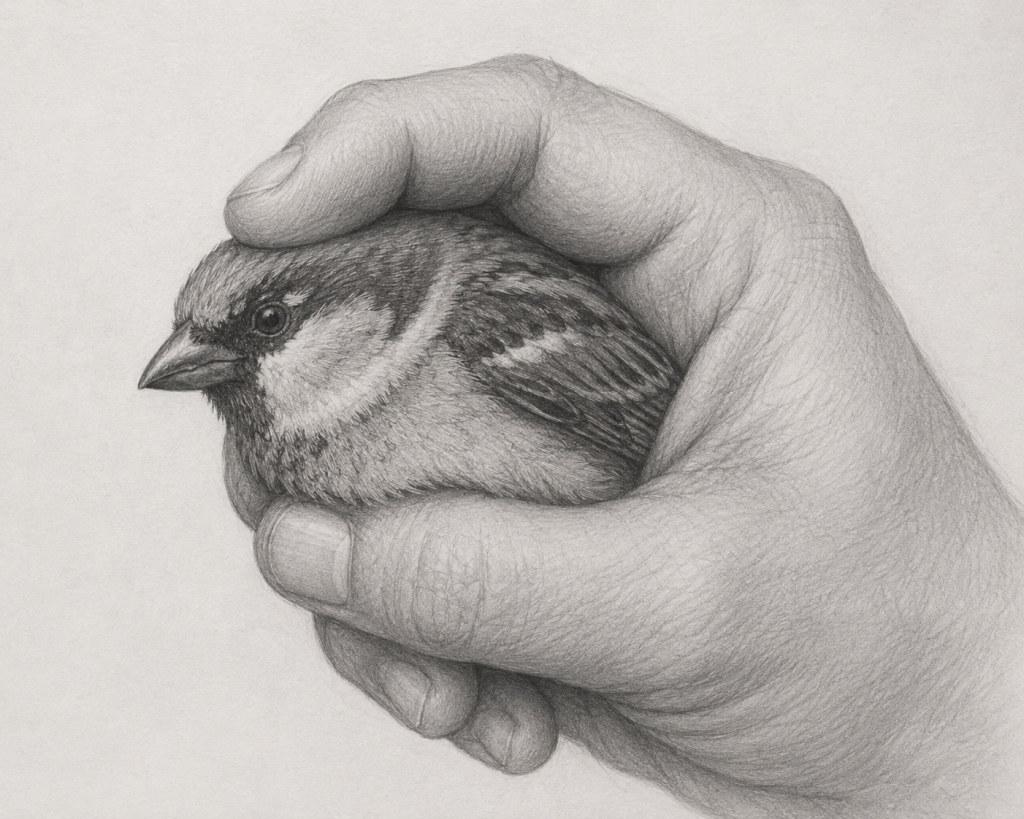
The Sparrow and the Path of Force
Many archers believe they must hold the bow tightly in order to control it.
Yet that is often where the problem begins.
Imagine a small sparrow resting in your hand.
Grip too tightly and you harm it.
Open your hand too much and it flies away.
Somewhere in between lies the right amount.
The Swedes call it:
lagom.
Not too much.
Not too little.
Just right.
That is exactly how the bow should rest in your hand.
Not gripped. Not released. Simply resting there naturally. Because the bow is looking for a calm path through your body.
This path begins at the base of the thumb.
Here lies the Reference Point between you and the bow.
From here, the force travels through the wrist and into the forearm.
Not through muscular effort. Not through gripping. But through a calm and clear connection.
Every unnecessary intervention changes this path.
A grip that is too tight introduces tension into the hand, arm, and shoulder.
A bent wrist redirects the force. An open hand often closes again at the last moment.
And an incorrect pressure point causes the bow to lose its way.
The arrow feels all of this. That is why good archery is often less about doing something and more about not doing something.
The sparrow reminds us not to take away the bow’s ability to breathe.
The Path of Force reminds us not to stand in the way of the bow’s power.
When both come together, something remarkable happens. The bow rests quietly in your hand.
The force finds its path.
And the arrow is allowed to fly.
Not because you forced it.
But because you allowed it.
The String Grip
The Connection to the Arrow
The arrow lies between the archer and the target. Between them, there is only one connection:
The string.
How we hold this connection has a profound influence on the entire shot. Many archers refer to this as the anchor. At Mellansken, we see it a little differently.
Before we can arrive at a Reference Point, we first need a calm and reliable connection to the string.
For this, we use three fingers.
The index finger. The middle finger. The ring finger. They carry the load of the draw.
The calmer this connection becomes, the calmer the shot can become later.
That is why good shooting begins not with strength.
But with a clean connection between hand, string, and arrow.
The Mediterranean Grip
The Classic Connection to the String
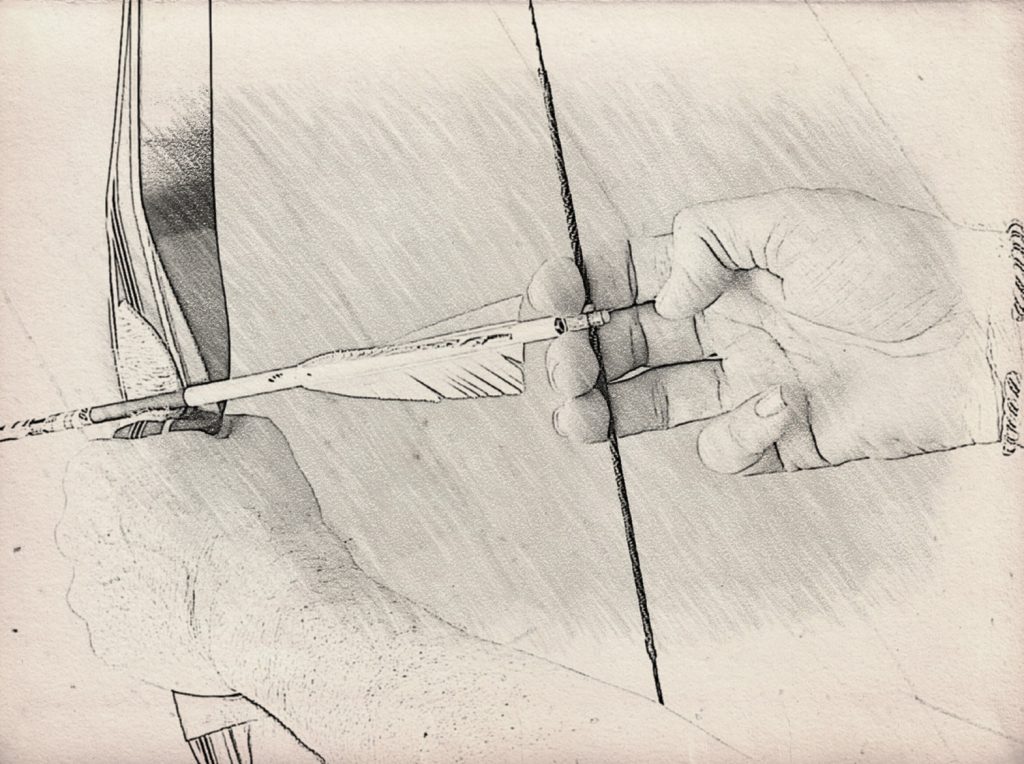
The Mediterranean Grip is the oldest and still the most widely used method of drawing a bowstring.
The index finger rests above the arrow. The middle and ring fingers rest below it.
The arrow is guided lightly between the fingers. Not squeezed. Not held. Not pulled.
The fingers carry the string. The arrow accompanies the shot.
We hook the string no deeper than the first finger joint.
This allows the string to be held securely while still leaving the fingers cleanly.
The Mediterranean Grip has been used for centuries and remains one of the most common techniques in traditional archery.
Many of the most influential figures in traditional archery shot this way. Not because it is the only solution.
But because it is simple. Reliable. And effective. Another advantage lies in the design of many traditional bows. Most production bows are built to perform particularly well with a Mediterranean Grip.
The load is distributed evenly between the limbs. The bow can develop its power calmly and efficiently.
That is why the Mediterranean Grip is an excellent starting point for many archers. Not because it is perfect. But because it has proven itself across generations.
The Three-Under Grip
Three Fingers Beneath the Arrow

In the Three-Under Grip, all three drawing fingers rest beneath the arrow.
The index finger. The middle finger. The ring finger.
The arrow rests above the fingers and is guided rather than held. The greatest difference compared to the Mediterranean Grip is that the arrow sits closer to the eye.
Many archers find this comfortable because it makes the arrow easier to perceive.
For this reason, the Three-Under Grip has become popular in modern traditional archery.
Whether an archer shoots better with the Mediterranean Grip or the Three-Under Grip cannot be answered universally. Accuracy does not come from choosing a particular technique. Accuracy comes from repetition.
From trust.
And from a technique that suits the individual archer.
That is why, at Mellansken, we are not searching for the one correct solution.
We are searching for a solution that works for you. The best string grip is not the newest.
Not the oldest. Not the most popular.
The best grip is the one you can shoot calmly, confidently, and repeatedly.
How Is the Bow Held?
Many discussions in archery revolve around a simple question:
Should the bow remain perfectly vertical at full draw, or should it be held at an angle?
At Mellansken, there is no strict rule.
But there is a clear recommendation. The bow is held at a slight angle. Not because it looks better.
Not because it is tradition.
But because it serves instinctive archery.
In instinctive archery, we are not searching for a sight picture.
We are searching for perception.
With both eyes open, we take in the world before us.
The target. The distance. The surroundings. The path the arrow is about to travel.
Most of this information never reaches conscious thought. Yet the brain processes it.
Moment by moment. Shot by shot. A slightly angled bow supports this process.
It opens the field of view.
The bow moves a little further away from the centre of perception.
The target becomes clearer. The gaze becomes broader. Freer. More natural.
Perhaps it is like travelling through the archipelago in a canoe.
If you only look at the bow of the canoe, you see very little.
Lift your gaze and you begin to see the water, the wind, the islands, and the direction all at once.
The same is true of the bow. We do not look at it.
We look through it. And that is why, at Mellansken, the bow is held at a slight angle.
Not merely as a technique.
But as an invitation to perceive more of the world.
The Angle of the Bow
A Natural Inclination
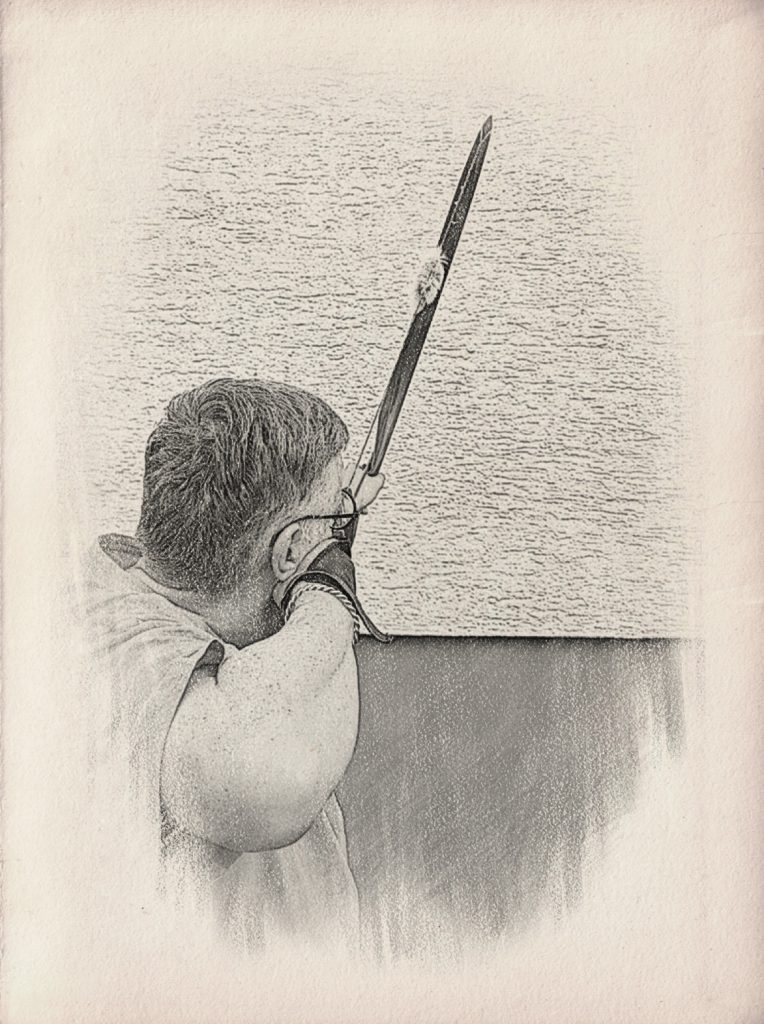
The bow is not tilted by bending the wrist. It is not tilted by twisting the body.
The movement originates from the centre of the body. The entire T-shape of the archer inclines slightly.
Calmly. Naturally. Like a tree leaning gently into the wind. Not from the hips. Not from the wrist.
But as one connected movement of the whole system. Your stability remains unchanged.
For right-handed archers, I often use a simple image.
Imagine a large clock above your head.
Directly overhead is twelve o’clock.
Now allow the bow to settle at approximately one o’clock.
Not further. Not less. Just enough to feel natural.
And most importantly:
Enough that you can find the same position again and again.
Because instinctive archery is not searching for a precise angle. It is searching for repeatability.
The lower limb points slightly away from the body. For left-handed archers, the picture is simply mirrored.
As you raise the bow and move into the draw, the angled position often appears almost by itself.
It does not feel manufactured.
It feels discovered.
Closing Thoughts on Bow Angle
It is entirely possible to shoot instinctively with a vertical bow. Yet the slight inclination opens the field of view.
The bow moves a little further from the centre of perception.
The target remains clear. The world between you and the target remains visible. Perhaps that is the most important reason of all. We do not see the bow. We look through it.
And that is why, at Mellansken, the bow is held at a slight angle.
The Reference Point
The Place Where Repetition Begins
Accuracy does not begin with the target. Accuracy begins with repetition.
Every good shot depends on certain things happening consistently.
The stance. The draw. The posture.
And the place where the drawing hand arrives at full draw.
At Mellansken, we call this place the
Reference Point.
The Reference Point provides orientation. It helps the string return to the same place with every shot.
Not with millimetre precision. Not through tension. But reliably.
Because the body learns through repetition. The more often it is allowed to perform the same movement, the more natural the shot becomes.
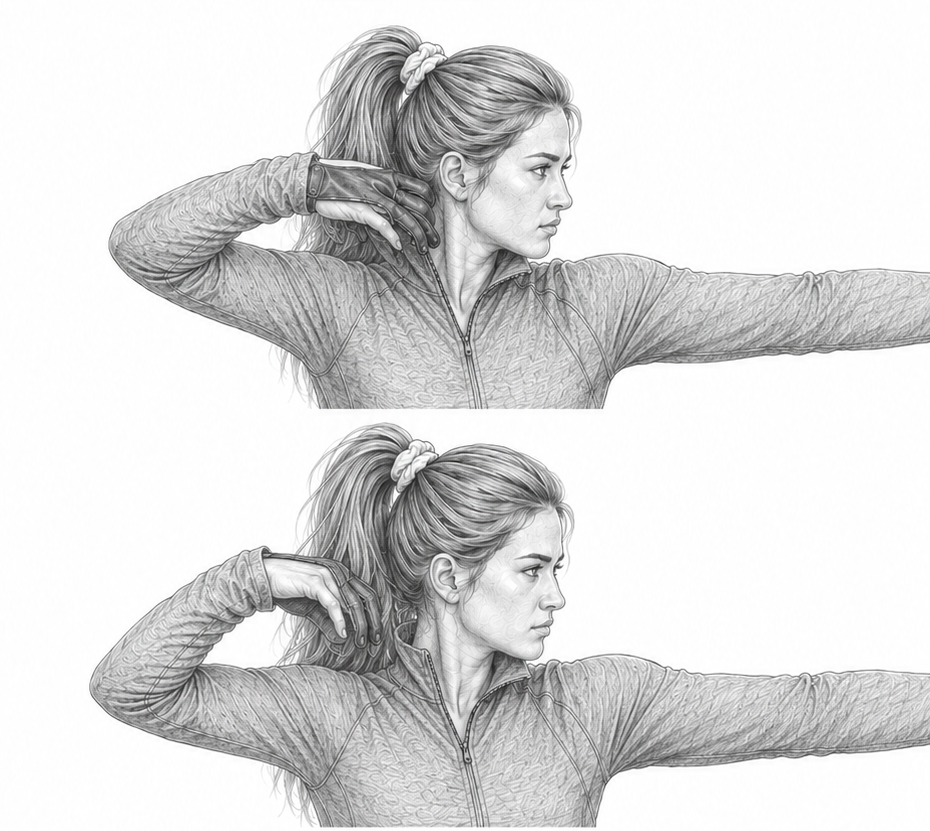
The Reference Point helps make this possible. For many archers, this point is found at the corner of the mouth. There, the drawing hand finds a clear and repeatable point of contact.
Yet no two archers are exactly alike. Face shape. Draw length. Personal preference.
And sometimes even a pair of glasses. All can influence the best solution. That is why we are not searching for the perfect Reference Point.
We are searching for your Reference Point.
A point you can find reliably.
Because the Reference Point does not need to be the same for everyone.
It simply needs to be the same for you.
The High Reference Point
Middle Finger at the Corner of the Mouth
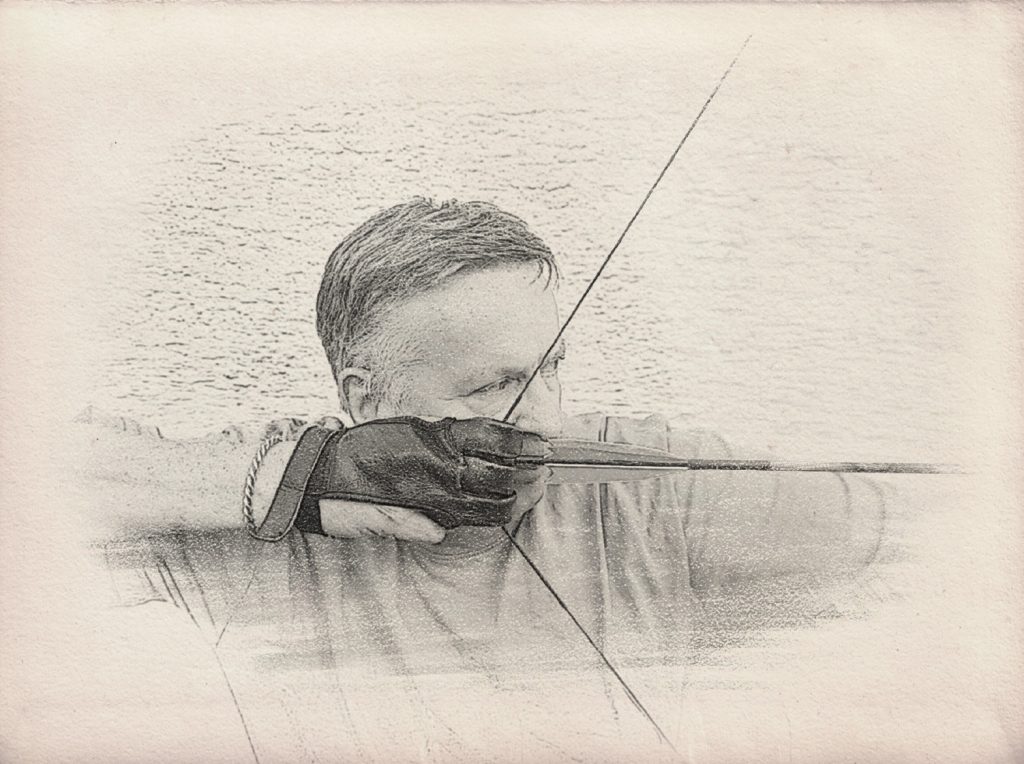
With the High Reference Point, the middle finger touches the corner of the mouth at full draw.
This places the arrow in a very favourable relationship to the eye.
Close enough for the subconscious mind to process distance and target image efficiently. Yet not so close that the arrow becomes the primary aiming reference.
Many experienced instinctive archers prefer this Reference Point because it creates a natural relationship between eye, arrow, and target. In most cases, no additional reference is required.
The corner of the mouth is enough. Archers using the High Reference Point should ensure that the string does not touch either the face or the frame of their glasses at full draw.
Only then can the shot remain calm and repeatable.
The Low Reference Point
Index Finger at the Corner of the Mouth
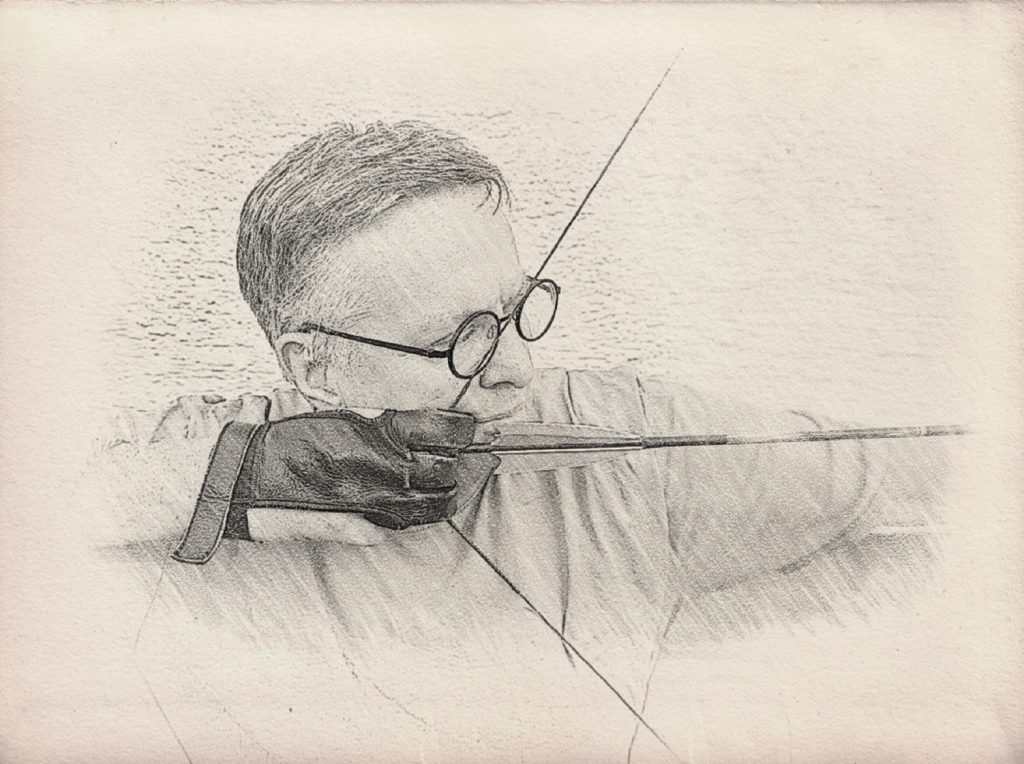
With the Low Reference Point, the index finger touches the corner of the mouth at full draw. This increases the distance between eye and arrow slightly. For instinctive archery, however, it remains well within an effective range. For archers who wear glasses, this option is often preferable.
A higher Reference Point may allow the string to contact the frame or strike the glasses during the shot.
The Low Reference Point creates additional space and allows a cleaner shot process.
It is not a compromise. It is a fully valid alternative. The important question is not which Reference Point is theoretically superior. The important question is which one works reliably for you. The best Reference Point is not the highest. Not the lowest.
But the one you can find again with every shot.
The Distance Between Eye and Arrow
The Reference Point influences the distance between eye and arrow.
This distance matters. Too much distance is not ideal. Too little distance is not ideal either.
Imagine two extremes. In the first, the drawing hand rests at the hip. The distance between eye and arrow becomes very large. The arrow sits far outside the natural field of perception. The subconscious mind must work much harder to judge distance and target image consistently. Now imagine the opposite extreme.
The arrow sits directly beneath the eye. The archer begins to perceive the arrow consciously and use it as an aiming device.
Instinctive shooting gradually becomes system shooting.
Between these two extremes lies a range that has proven itself particularly effective for instinctive archery.
This is where the High and Low Reference Points exist. Both bring the arrow close enough to the eye without turning it into the primary aiming reference.
That is why there is no perfect Reference Point. There is only a range within which repetition, perception, and trust work together particularly well.
And that is where instinctive archery emerges.
A Moment of Stillness
The Reference Point is not a place where we wait. It is a place where we arrive.
When the drawing hand reaches the Reference Point, the draw is complete.
The bow is fully loaded. The force of the bow is held within the back. The target stands before you.
Now comes a brief moment of stillness. Not longer than necessary. Not shorter than useful.
Just a moment.
Roughly one second.
More happens during this second than many archers realise. We consciously perceive the target.
We feel the connection between body, bow, and arrow. We become present within the shot.
Then the arrow may fly. If we remain at full draw much longer, thinking often begins.
Doubt appears. Corrections begin. The shot loses its natural quality.
The opposite extreme is equally problematic.
The archer barely reaches the Reference Point before the arrow is already on its way.
Something is missing. Stillness. Between these two extremes lies a narrow space.
Long enough to arrive. Short enough to trust what has already been learned.
And it is precisely there that the best moment for Allowing begins.
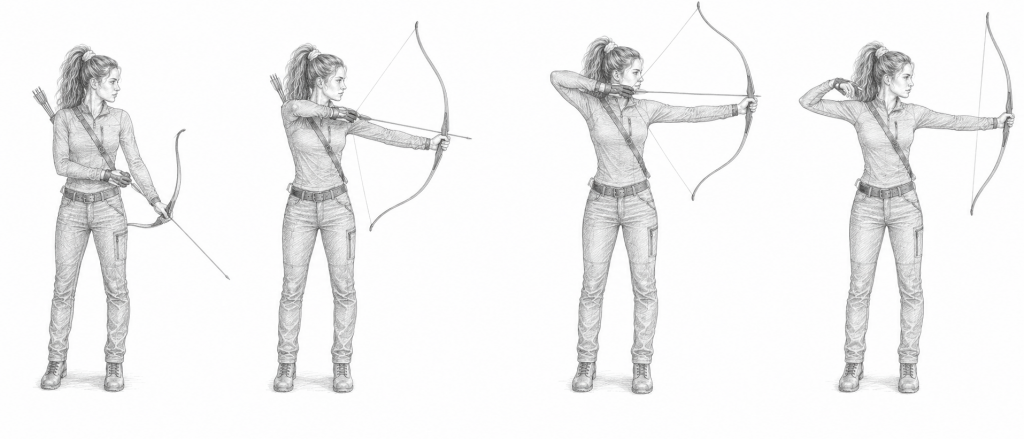
The Draw
Open the Back
Many beginners believe they draw the bow with the arm. Yet this is often where the first problem begins.
The arm moves the string.
The power of the draw comes from the back.
Anyone who attempts to draw a bow solely with the hand, forearm, or biceps quickly reaches their limit.
The movement becomes heavy. The shoulders tighten. The shot loses its calmness.
That is why, at Mellansken, we do not speak about pulling the bow.
We speak about Opening the Back.
As the draw begins, the drawing hand moves toward the Reference Point.
At the same time, the back opens. The shoulder remains low.
The drawing elbow moves calmly behind the archer.
The power develops between the shoulder blades. Not in the hand. Not in the forearm.
Not in the biceps. The bow is not pulled. The back opens.
For many archers, this becomes one of the most important discoveries on their journey.
Suddenly the draw feels lighter.
Calmer. More controlled. Not because the bow has become weaker.
But because the correct muscles have begun to work.
The back is among the strongest muscle groups in the human body.
It should therefore perform most of the work.
The better we learn to do this, the calmer the entire shot becomes.
And the easier it becomes for the drawing hand to find its Reference Point.
Full Draw
Structure Instead of Strength
At full draw, the bow places the greatest load on the entire shot process. For that very reason, the body should not work against the bow.
It should work with it.
A good full draw is not recognised by strength. It is recognised by structure. The shoulder blades remain calm and balanced.
The back stays upright and open. The Reference Point is clearly established.
The arrow and the drawing arm form one continuous line. If you extend the line of the arrow behind the archer, it should pass through the centre of the drawing elbow.
This creates the characteristic T-shape of the archer.
That structure allows the force of the bow to be carried by the larger muscles of the back.
The archer needs to hold less. The body can work more efficiently.
That is why a good full draw often feels surprisingly light.
Not because there is less force. But because the force has found its proper path.
Body Position
Stillness Before the Shot
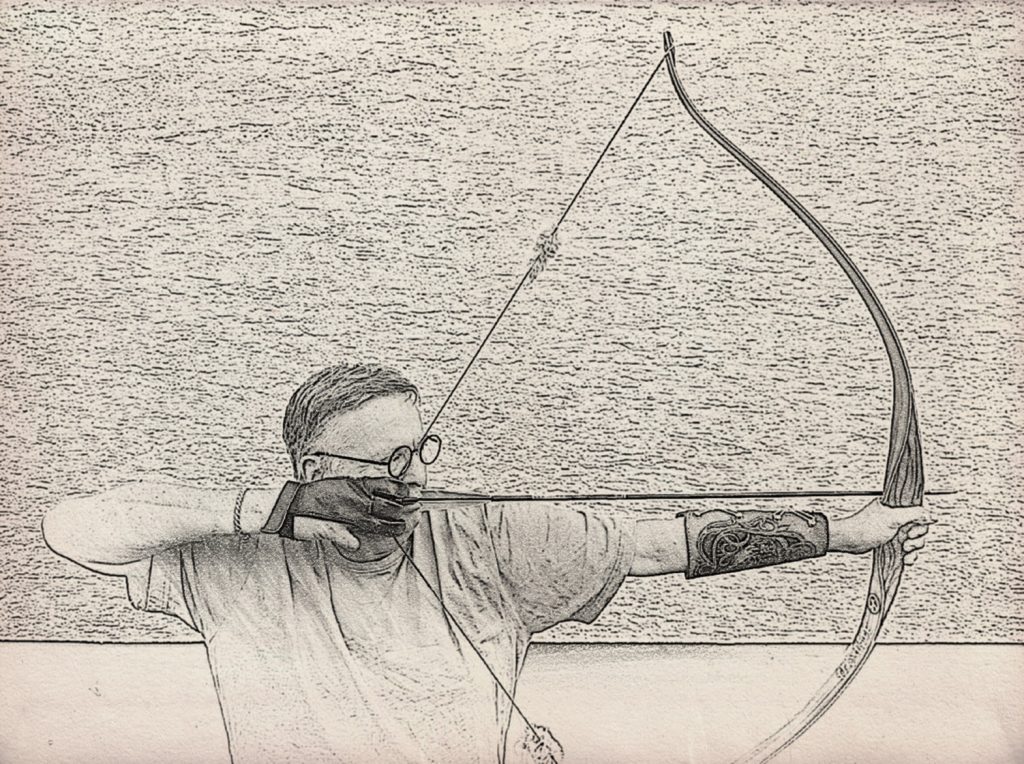
At full draw, everything is ready. No more. No less.
The Swedes would say:
lagom.
Both shoulder blades rest calmly in balance.
The back is upright and open. The bow arm extends its path forward. The drawing arm continues that path behind you.
Between them lies the arrow.
Calm. Clear. Straight.
The Reference Point has been found.
Now nothing new needs to happen. The muscles of the back maintain the structure. Not through force.
But through connection. If you extend the line of the arrow behind you, it should pass through the centre of the drawing elbow.
Then the shape we are looking for appears.
A clear T.
Like a signpost standing among the skerries. Nothing pushes. Nothing pulls. Everything supports.
In this moment, the force of the bow is distributed evenly through the larger muscles of the back.
The body works with the bow.
Not against it.
If the bow arm rises too high, the drawing elbow lifts, or the bow arm is overextended beyond its natural position, the system loses its balance.
The Path of Force becomes interrupted.
That is why we are not searching for the strongest position.
We are searching for the calmest one.
The most natural one.
The position in which the bow can pass its force through you.
And it is precisely there that the moment before Allowing begins.
Allowing
The Moment the Arrow Flies
Many archers believe that the most important part of the shot is releasing the fingers.
Yet that is often where the problem begins.
Because the moment we try to release actively, we interfere with something that is already ready.
At full draw, everything is present.
The stance. The Reference Point. The Path of Force. The connection to the back. Nothing new is required.
Only trust.
When the draw continues through the back, Allowing happens almost by itself.
The fingers do not consciously open. The string leaves the hand.
The arrow takes over.
The drawing hand then continues calmly backward. Not because we deliberately move it there.
But because the Path of Force continues. A good shot is often recognised by the absence of anything dramatic.
No sudden movement. No jumping hand. No conscious opening of the fingers. The shot appears calm.
Almost unspectacular.
And that is precisely why it is good. Our attention is not on the fingers.
It is on the back.
The place where the force originates.
As long as the back continues along its path, the string can leave the fingers with minimal interference.
The arrow receives a clearer direction. Its flight becomes calmer. The stabilisation phase becomes shorter.
The groups become more consistent. That is why, at Mellansken, we do not practise releasing.
We practise allowing.
And when the path is correct, Allowing happens by itself.
Mellansken:
The arrow takes over.
Technically, both describe the same event.
But they create a very different understanding.
Follow-Through
Giving the Arrow Its Path
Many archers believe the shot is finished the moment the string leaves the fingers.
Yet an important part of the shot still remains.
The Follow-Through.
The arrow is travelling. And we remain. The bow arm stays calm for as long as the arrow is in flight.
The gaze remains on the target with both eyes open.
Nothing rushes ahead. Nothing reaches for the next arrow. We accompany the flight.
Like watching a canoe slowly disappear between the islands of the archipelago.
Not because we can influence it. Not because we can hold on to it.
But because we want to see where its journey leads.
Something remarkable happens while the arrow is travelling.
The eyes collect information. The trajectory. The distance. The movement of the arrow.
The moment of impact. All of these impressions are stored. Not consciously.
But in the place where instinctive archery is learned.
The subconscious mind learns.
Shot by shot. Arrow by arrow. That is why the shot is not complete until the arrow’s journey is complete.
Not before.
An archer who lowers the bow during flight, moves the head, or is already thinking about the next arrow interrupts this learning process.
They remove part of the information needed for the next shot.
That is why we follow through.
Not because of discipline.
Not because of tradition.
But because this is where the feeling develops that we will later trust.
Follow-Through is the moment when the arrow tells its story.
And the archer learns to listen.
Learning Through Perception
When the arrow has reached its destination and the bow slowly lowers, another part of the shot begins.
Now we observe. Now we learn. We ask ourselves: Where is the arrow? Why is it there? What did this shot show me?
What can I take with me into the next arrow?
We are not searching for mistakes.
We are searching for understanding.
Because instinctive archery does not learn through repetition alone.
It learns through perception.
Every arrow leaves a trace. Not only in the target. But within us.
That is why we observe the flight carefully.
The trajectory. The speed. The direction. The moment of impact. All these impressions are stored.
Gradually, they become what we later call feeling.
Yet this feeling is not a mystery. It is the sum of many carefully observed arrows.
That is why bright fletchings can be so valuable.
Not only because they help us find an arrow.
But because they help us see its journey.
Every visible arrow flight becomes a small lesson.
Every carefully observed shot expands the experience we will later trust.
And with every arrow, perception grows.
With every arrow, trust grows. And little by little, what once felt difficult begins to feel natural.
Not because the archer thinks more.
But because the archer has learned to see.
And eventually, to trust what has been seen.
A perfect form
Finding the Dominant Eye
There is a simple way to identify your dominant eye.
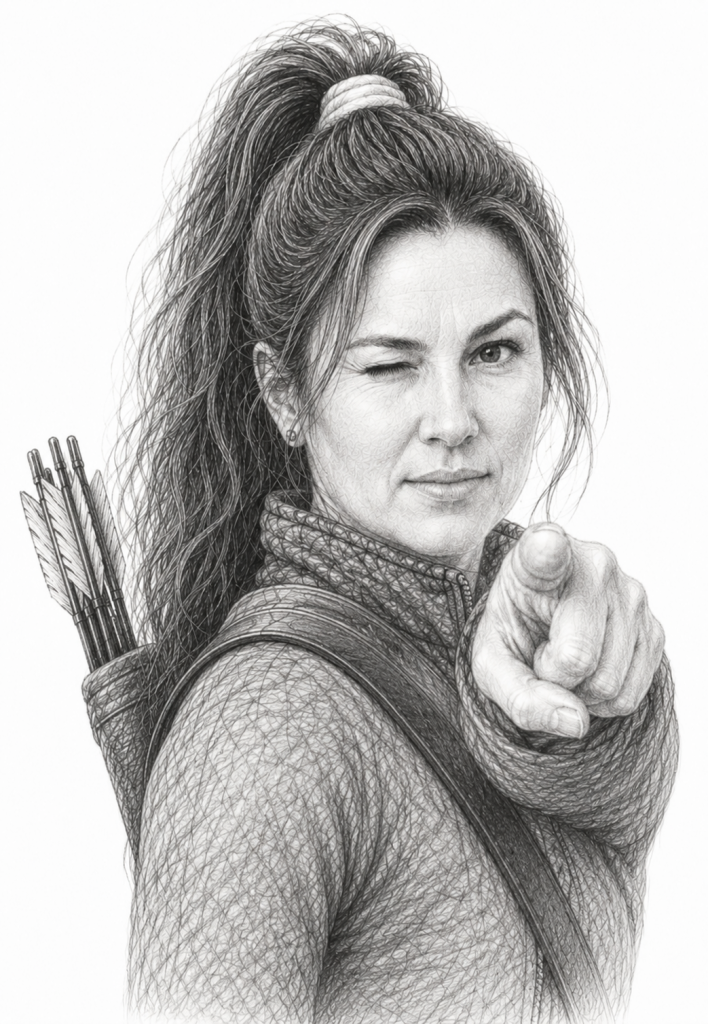
Choose a small point five to ten meters away. Look at it with both eyes open and point directly at it with your finger.
Now close one eye and then the other.
If your finger remains on the point, the open eye is your dominant eye.
If your finger appears to jump to the side, the eye you just closed was the dominant eye.
The test is simple and reliable. It shows which eye gives the arrow its direction.
Cross-Dominance
Sometimes the dominant hand and the dominant eye are not on the same side.
A right-handed archer shoots beneath the right eye, but the dominant eye may be the left one.
This is called cross-dominance.
For a left-handed archer, the situation is reversed.
When Does It Matter?
Not every case of cross-dominance needs a solution.
For us, it only becomes relevant when arrows consistently land to one side of the target despite good technique.
Then it is worth taking a closer look at your vision.
Because sometimes the cause is not the arrow.
But the eye that gives it direction.
Equipment
Which Bows Are Suitable for Beginners?
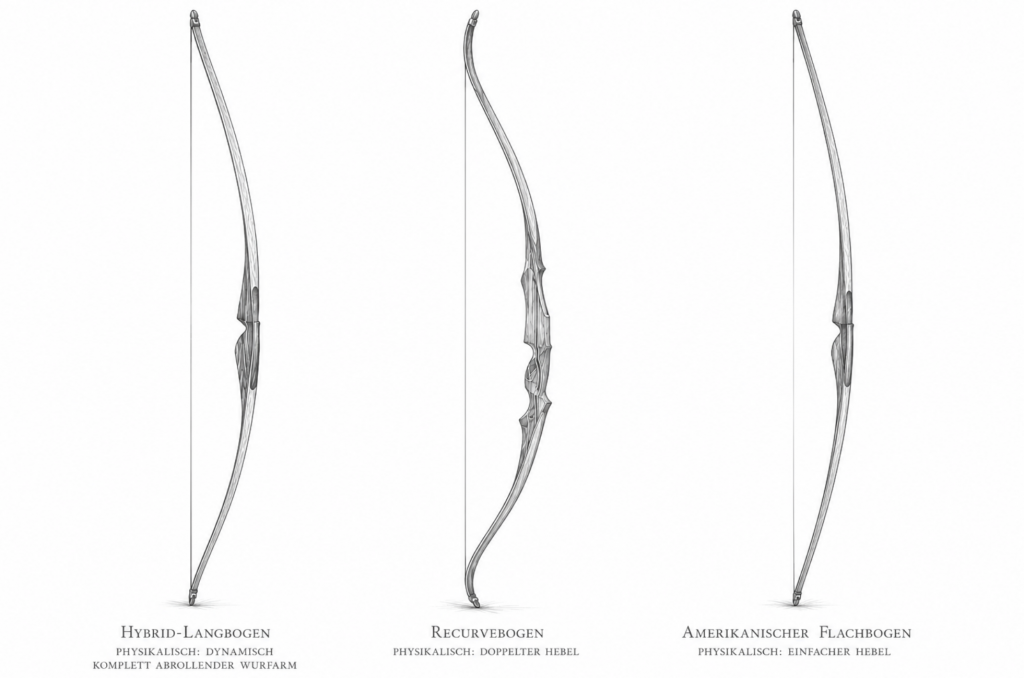
Three types of bows can be suitable for beginners. What matters most is not the bow design itself, but choosing an appropriate draw weight and a bow that fits you.
Longbows offer a particularly traditional shooting experience.
Recurve bows are powerful and widely used.
Hybrid bows combine characteristics of both designs and are known for being comfortable and forgiving.
At Mellansken, many archers begin with a hybrid bow because it offers a balanced combination of performance, shooting comfort, and forgiveness.
More important than the type of bow, however, is that the bow matches your height, draw length, and strength.
A bow that is too heavy makes learning unnecessarily difficult.
What Is a Hybrid Bow?
A hybrid bow is a modern development of the traditional longbow. It combines characteristics of both the longbow and the recurve bow within a single design.
As a result, it offers an excellent balance of shooting comfort, performance, and forgiveness. Many archers appreciate hybrid bows because they are pleasant to shoot while maintaining the traditional aesthetics of a longbow.
For this reason, hybrid bows have become one of the most popular bow types in traditional and instinctive archery.
What Is a Longbow?
The longbow is one of the oldest bow designs in the world and has been used for hunting, warfare, and sport for thousands of years.
Its defining characteristics are its simple construction, elegant shape, and traditional character. Many archers appreciate the direct shooting experience and the strong connection to the history of archery.
To this day, the longbow represents simplicity, tradition, and the roots of archery.
What Is a Recurve Bow?
A recurve bow is a bow whose limb tips curve forward away from the archer. This distinctive design allows for efficient energy transfer to the arrow and provides excellent performance in a relatively compact form.
Recurve bows are used in both traditional and modern target archery. They are known for their power, versatility, and widespread popularity.
Their design provides dynamic shooting characteristics and a high level of shooting comfort.
What Are a Finger Tab and an Arm Guard?
A finger tab or shooting glove protects the drawing fingers from the pressure of the string and makes shooting more comfortable. Depending on personal preference, archers may use either shooting gloves or tabs.
An arm guard protects the forearm from contact with the bowstring. Beginners in particular benefit from using one until proper posture and movement patterns become second nature.
Both pieces of equipment improve comfort and are considered part of the recommended basic equipment for traditional archery.
How Heavy Should My First Bow Be and Why Is a Bow That Is Too Heavy a Mistake?
For most adults, a sensible beginner draw weight lies between 20 and 30 pounds. The ideal draw weight depends on your physical strength, draw length, and training goals.
At Mellansken, the principle is simple: it is better to start with a lighter bow and develop sound technique than to struggle with excessive draw weight.
A bow that is too heavy makes it difficult to learn proper shooting technique. Movements become tense, concentration decreases, and mistakes appear more quickly.
A lighter bow allows for more controlled repetitions and therefore faster progress. Especially for beginners, less is often more.
What Is More Important: The Bow or the Arrow?
Both must work together. In practice, however, the importance of the arrow is often underestimated.
Even a high-quality bow cannot perform at its best if the arrows do not match the draw weight, draw length, and shooting style.
Conversely, properly matched arrows can significantly improve accuracy.
That is why the arrow is at least as important as the bow.
Should I Buy My First Bow Online?
For beginners, personal advice is usually the better option. The bow, arrows, and draw weight should match your draw length, physical strength, and intended use.
An experienced archery dealer or a beginner course can help you avoid common mistakes and unnecessary purchases.
For that reason, I recommend choosing your first bow only after receiving professional guidance.
How Important Are Feather Color and Feather Length?
Many beginners underestimate the importance of feather color. In reality, it can have a significant impact on training.
The better you can follow the flight of the arrow, the easier it becomes to recognize mistakes and learn from every shot. For this reason, feathers should primarily be highly visible. The ideal color depends on lighting conditions, background contrast, and individual factors such as color blindness.
Feather length also influences arrow flight. Larger feathers stabilize the arrow more quickly, while smaller feathers generally create less drag.
For beginners, however, feather visibility is more important than choosing the perfect feather length.
How Important Is Arrow Fletching?
Very important.
Fletching stabilizes the arrow in flight and can also provide valuable feedback about the quality of the shot. At Mellansken, I recommend choosing feather colors based on visibility rather than appearance.
The better you can observe arrow flight, the faster you will learn and the easier it will be to identify mistakes.
Which Arrows Do I Need – Carbon or Wood?
Both wooden and carbon arrows can perform well. However, for most beginners, I recommend carbon arrows.
Carbon arrows are more durable, more consistent in manufacture, and considerably easier to maintain than wooden arrows. They generally tolerate the realities of beginner practice much better and require replacement less often.
Wooden arrows have their own charm and are an important part of traditional archery for many people. They are beautiful, but they also tend to increase the frequency of visits to your archery supplier.
For this reason, I generally recommend carbon arrows for beginners.
For me, wooden arrows are more a choice for experienced archers or enthusiasts of traditional equipment.
What Does Draw Weight Mean?
Draw weight describes the amount of force required to draw a bow. It is usually measured in pounds (lbs).
The marked draw weight on a bow almost always refers to a draw length of 28 inches (28″), which is the international standard in archery.
For example, if a bow is marked “50 lbs @ 28”, it means that the bow produces a draw weight of 50 pounds when drawn to 28 inches. Archers with a shorter draw length will generally pull less weight, while archers with a longer draw length will pull more.
For beginners, however, the most important factor is not maximum draw weight but a bow that can be shot comfortably and with control.
Good technique is more important than having as many pounds on your fingers as possible.
How Much Does It Cost to Get Started?
Getting started in instinctive archery is often less expensive than many people expect.
For a basic setup consisting of a bow, arrows, an arm guard, and a shooting glove or tab, you can generally expect to spend between €150 and €300, depending on the equipment chosen. Additional costs may apply for a beginner course.
I recommend that beginners invest first in good advice and equipment that truly fits them.
A bow that is too cheap often ends up costing more than a good bow.
Training
How Often Should I Practice?
Consistency is more important than long training sessions. Practicing for 15 to 20 minutes several times a week will usually produce better results than a single long session on the weekend.
What matters most is not the number of arrows you shoot, but the quality of the repetitions.
Can I Teach Myself Archery?
In principle, yes. Many of the fundamentals can be learned without a coach.
However, an experienced instructor can identify and correct mistakes before they become deeply ingrained.
This saves time, frustration, and often money.
For that reason, I recommend that beginners attend at least one introductory course.
How Can I Practice at Home? Is It Safe to Practice at Home?
Yes, provided that safety can be guaranteed at all times.
The target must be set up securely, and there must be no possibility of people, animals, or property being endangered.
For many archers, short-distance practice at home is an excellent way to improve technique, movement patterns, and shooting rhythm.
How Can I Improve My Accuracy?
Most archers improve their accuracy not through greater strength or better equipment, but through deliberate practice.
Sound technique, consistent repetition, and the ability to learn from every shot are the most important factors.
Hitting the target is not a matter of luck.
It is a learned skill — and trust in that skill.
What Mistakes Do Beginners Make Most Often?
The most common mistakes are using a draw weight that is too heavy, overthinking during the shot, and expecting quick results.
Archers who focus on sound movement, regular practice, and patience usually make the greatest progress.
How Long Does It Take to Shoot Consistently?
That depends on training frequency, experience, and individual circumstances.
Initial success often comes quickly. Consistent shooting, however, develops over months and years.
Accuracy is not a destination you reach.
It is a skill you continue to develop throughout your journey.
Is Strength Training Beneficial?
Yes, but it cannot replace archery practice.
Good overall strength and stable musculature can support shooting performance and help prevent injuries.
For most archers, however, technique, movement quality, and regular shooting practice are more important than maximum strength.
How Should I Deal with a Plateau or a Performance Slump?
Performance slumps are a natural part of the learning process and are experienced even by highly skilled archers.
During such periods, it often helps to lower expectations slightly and return to the fundamentals. In many cases, reducing pressure is the fastest way back to good shooting.
Trust what you have already learned.
Skills do not disappear overnight.
Philosophy
What Does Mellansken Mean?
Mellansken originates from my love for Sweden and the Stockholm archipelago.
The name is derived from the Swedish expression mellan skären —
“between the skerries” or “between the islands.”
For me, however, Mellansken describes more than a place.
It describes a state of being.
A place between tension and relaxation.
Between control and trust.
Between the person we are and the person we can become.
Perhaps that is where true freedom is found.
Not in the target.
But on the path toward it.
And perhaps it is there that we remember how natural the human being truly is.
Why Is Archery About More Than Hitting the Target?
Hitting the target is important. After all, we shoot an arrow at a target in order to hit it.
Yet most people do not stay with archery for years because they hit the target.
They stay because they discover something else.
Archery demands concentration.
Patience.
Presence.
It shows us how we deal with mistakes, how we learn, and how we handle pressure.
The arrow does not always hit the target.
But every shot tells us something about ourselves.
That is why instinctive archery is about more than accuracy.
It is about the person behind the bow.
What Does “Allowing” Mean in Instinctive Archery?
Many beginners try to control the shot.
They want to force the perfect moment and avoid every mistake.
Yet the more we try to control, the more difficult the shot often becomes.
Allowing does not mean becoming passive.
It means doing the necessary work beforehand and then trusting what has been learned.
The body is allowed to do what it has learned to do.
The arrow does not become good through control.
It becomes good through practice — and through the ability to allow that practice to emerge at the right moment.
Why Is Trust More Important Than Control?
Control has its place in learning.
Trust has its place in shooting.
Anyone who tries to consciously manage every movement will eventually reach their limits.
The shot lasts only a moment.
There is almost no time for conscious corrections.
That is why we train.
That is why we repeat.
That is why we gain experience.
The bow does not teach you to aim — it teaches you to trust.
Trust does not mean hoping for luck.
Trust means being able to rely on something that has been built through practice and experience.
What Does Nature Have to Do with Archery?
For me, nature and traditional archery belong together.
Nature asks nothing of us. It does not judge. It does not compare.
That is precisely why many people find it easier there to slow down and focus on the present moment.
Among trees, rocks, and water, archery often becomes more than simply shooting at a target.
It becomes an encounter with nature — and sometimes with ourselves.
Perhaps that is one of the reasons why archery in nature feels so natural to so many people.
Why Do People Still Shoot Simple Bows Today?
Because it is not always about finding the easiest way to hit the target.
A simple bow challenges us to develop skill rather than rely on technology.
Every successful shot is built on practice, experience, and trust in what we have learned.
Many people value precisely this simplicity.
It does not reduce the archer to equipment and technology.
Modern life already provides enough of that.
It brings us closer to the original roots of archery and reminds us that less can sometimes be more.
Perhaps that is where the unique fascination of a simple bow lies.
What Can We Learn from Traditional Archery?
Traditional archery teaches us that not everything becomes better through more technology or more control.
It reminds us of the importance of patience, concentration, and regular practice.
It shows us that skill takes time to develop and that trust must grow.
Perhaps one of its most valuable lessons is that not everything can be forced.
Some things emerge only when we are willing to learn, to practice, and eventually to allow.
Why Do We Not Teach Through Perfection?
Because perfection is not an attainable destination.
People who constantly strive to be perfect often lose the joy of learning and the freedom to make mistakes.
Yet mistakes are exactly how we learn.
I believe that progress is more important than perfection.
Every shot can teach us something. Every missed shot reveals something we have not yet understood.
That is why Mellansken is not about becoming perfect.
It is about becoming a little better than yesterday.
Every single day.
What Does Presence on the Shooting Line Mean?
Presence means giving your full attention to this one shot.
Not to the previous arrow. Not to the next target. Not to the score.
Only here.
Only now.
Many mistakes are not caused by poor technique but because our thoughts are already somewhere else.
Presence brings us back to the moment.
Because we can only hit the target with this one arrow.
Sweden
Why Sweden?
For me, Sweden is more than a country.
It is a place of peace, openness, and nature.
Here, I rediscover many of the things that are often lost in everyday life: time, silence, and the opportunity to simply be present. This connection to nature and to a more conscious way of living also shapes Mellansken and the way I teach archery.

What Does Archery Have to Do with the Archipelago?
At first glance, not much. And at the same time, everything.
The archipelago represents tranquility, simplicity, and closeness to nature.
These are the very values that shape my understanding of traditional archery.
Both remind us that not everything needs to become faster, louder, or more complicated.
Sometimes the greatest freedom is found in simplicity.
Why Are Courses Held in Sweden?
Because the environment is part of the learning experience.
Swedish nature creates a setting that encourages concentration, calmness, and presence.
Far away from stress and distractions, many people find it easier to focus on what truly matters.
That is why Sweden is not just a course location for me.
It is an essential part of the Mellansken experience.
Can I Take an Archery Holiday in Sweden?
Yes.
Mellansken combines traditional archery with nature, outdoor living, and the unique atmosphere of Sweden.
It is not only about shooting a bow.
It is also about experiencing the landscape, the tranquility, and the Scandinavian way of life.
Why Is Swedish Outdoor Culture Important to Mellansken?
Swedish outdoor culture is built on a simple idea:
People belong outdoors.
Time in nature, movement in the fresh air, and a respectful relationship with the environment are natural parts of everyday life in Sweden.
This attitude also shapes Mellansken.
Not as a set of rules, but as a reminder of how beneficial a simpler and more nature-connected life can be.
What Makes the Stockholm Region and the Archipelago Special?
The Stockholm region combines the advantages of a modern capital city—with Stockholm being, in my opinion, the most beautiful city in the world—with a truly unique natural landscape.
Just beyond the city begins one of the world’s largest archipelagos, consisting of approximately
30,000 islands, skerries, rocks, and bays.
The combination of water, forests, open space, and Nordic tranquility makes this region a special place for many people.

Can I Visit Mellansken Even If I Have Never Shot a Bow Before?
Yes, absolutely.
Many participants at Mellansken hold a bow in their hands for the very first time.
No previous experience is required.
More important than experience are curiosity, openness, and a willingness to learn something new.
„Vissa platser besöker vi för första gången.
Och ändå känns det som att komma hem.„
„Some places we visit for the first time.
And yet it feels like coming home.„