
Why Skill Is Not Inborn
When people watch an experienced archer, everything often appears effortless.
The stance looks calm. The draw seems natural. The arrow flies toward the target as if it requires no effort at all.
From the outside, it can seem as though this ability has always been there.
But the brain is not born an archer. It becomes one.
Through learning. Through experience. Through repetition.
Every skilled archer once started with their very first arrow.
Learning Means Change
Every time we learn something new, our brain changes. New connections are formed.
Existing connections become stronger. Others lose their importance.
Neuroscientists call this process neuroplasticity.
In simple terms, this means: The brain can adapt. The brain can change. The brain can develop new abilities.
This ability remains with us throughout our lives. And it forms the foundation of every learning process.
Including instinctive archery.
Neuroplasticity – The Brain’s Superpower
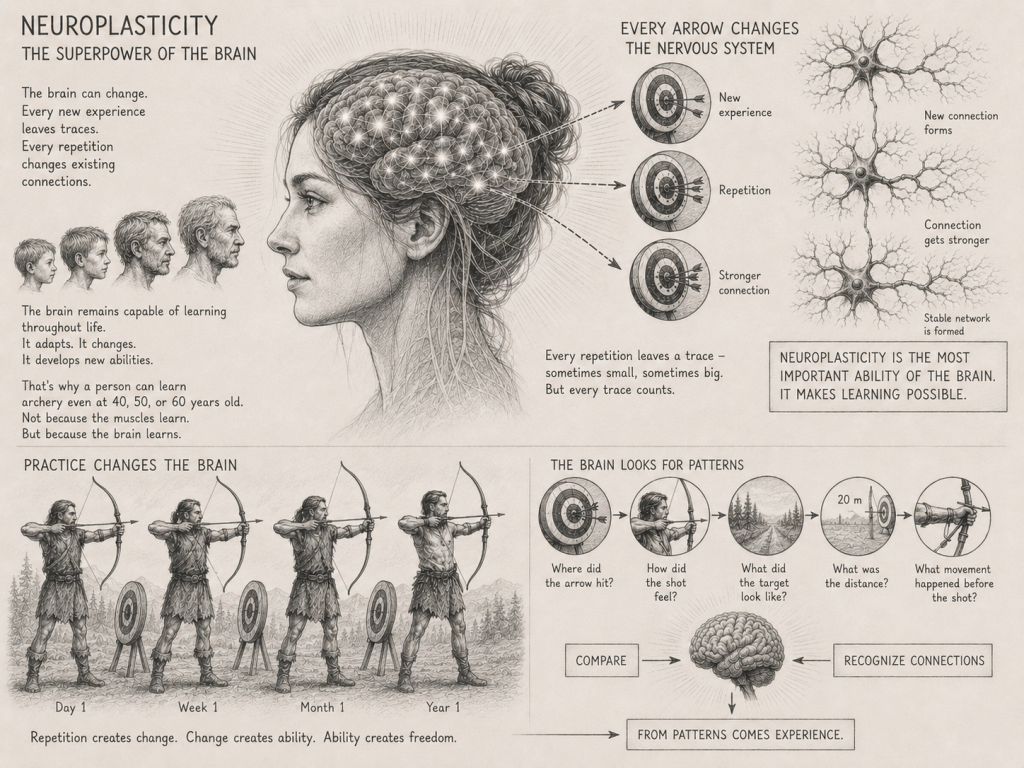
At first, the word may sound complicated. But the idea behind it is remarkably simple. Neuroplasticity means that the brain can change.
Every new experience leaves a trace. Every repetition strengthens existing connections. Every observed arrow provides new information.
For a long time, scientists believed that the brain was largely finished developing after childhood.
Today we know this is not true. The brain remains capable of learning throughout life.
It adapts. It changes. It develops new skills. That is why a person can learn archery at forty, fifty, or sixty years of age.
Not because the muscles are learning. Because the brain is learning. Every arrow changes the nervous system a little.
Sometimes the change is barely noticeable. Sometimes it becomes clearly visible. But every repetition leaves a trace.
That is why neuroplasticity may be the brain’s most important ability.
It makes learning possible.
The Brain Searches for Patterns
The brain does not learn individual arrows. It learns patterns. After every shot, it receives information.
Where did the arrow land? How did the shot feel? What did the sight picture look like?
What was the distance? What movement preceded the shot? The brain begins comparing this information.
It searches for relationships. It searches for repetition. It searches for patterns.
And over time, experience emerges from those patterns.
Why Fifty Arrows Are Often Not Enough
Many beginners experience the same disappointment.
They attend a course. They understand the technique. They shoot fifty or even one hundred arrows.
And yet they still do not shoot consistently. The problem is rarely understanding. The problem is experience.
The brain needs repetition. Not ten repetitions. Not fifty.
But often hundreds or even thousands, depending on the individual.
Only then does the nervous system begin building stable movement patterns.
This is not a failure of the archer.
It is simply how the brain works.
Knowledge Is Not Skill
Perhaps you know this from other areas of life. Someone explains how to ride a bicycle.
You understand every word. Yet after the explanation, you still cannot ride.
Why?
Because knowledge and skill are not the same thing.
Knowledge comes from understanding.
Skill comes from experience.
Only after the brain has experienced a movement many times does it begin to become part of what we can actually do.
The Arrow Becomes the Teacher
Every arrow provides feedback. Every hit. Every miss. Every flight path. Every mistake.
The nervous system uses this information to refine its internal models.
That is why the brain does not learn only through success.
It learns through feedback.
In this way, the arrow becomes a teacher. Not because it speaks.
But because it is honest.
Feedback Matters
Many archers make a mistake without realizing it. They shoot an excellent arrow. The shot feels clean.
The arrow lands exactly where it should. And what happens?
Nothing.
The archer simply moves on as if it were expected.
As if the shot carried no significance. Then the next arrow misses.
And suddenly frustration appears. The criticism begins. The disappointment becomes noticeable.
The nervous system now experiences something interesting:
The good shot received very little attention.
The poor shot received a great deal of attention.
Yet the brain responds particularly strongly to events connected with emotion.
Not because emotions are always correct.
But because emotions signal importance.
For this reason, it can be helpful to consciously acknowledge a good shot with a quiet internal “Yes.”
Not with exaggerated excitement. But with awareness. With appreciation. With a brief moment of observation.
What felt good? What was different? What can I learn from this? Successful shots contain valuable information as well.
And sometimes we learn more from one consciously observed hit than from ten misses accompanied by frustration.
Learning Often Happens Unnoticed
One of the most interesting aspects of learning is that we cannot directly observe much of it.
The brain works quietly in the background. It gathers experience. Organizes information.
Compares patterns. Often we notice the results only weeks later. A movement feels easier.
A shot feels calmer. A technique feels more natural. The visible improvement appears suddenly.
But the learning behind it began long before.
From Thinking to Doing
At the beginning, the archer thinks about many things. The stance. The draw. The drawing hand.
The shoulders. The reference point. As experience grows, this begins to change.
The brain gradually takes over more and more of these tasks automatically.
Not because the archer knows less. But because the archer has learned more.
The movement becomes familiar. The sequence becomes natural. Thinking moves slightly into the background.
Skill moves into the foreground.
Learning Takes Time
Perhaps this is the most important lesson of all. The brain cannot be rushed. It needs repetition.
It needs experience. It needs observation. It needs time.
Once we understand this, we become more patient with ourselves.
Because we realize something important: Progress is not absent.
The brain is already working.
Even when the results are not yet visible.
How Does the Brain Learn Archery?
The simplest answer is: Through experience. The brain observes. It compares. It recognizes patterns.
It stores relationships. And with every arrow, its internal model becomes a little more precise.
That is why skill is not developed in a single day.
Not through a single course.
And not through a single good shot.
It emerges from countless experiences that gradually connect over time.
Arrow by arrow. Shot by shot. Day by day.
And eventually something remarkable happens.
What required conscious attention yesterday feels completely natural today.
That is the moment when knowledge begins to become skill.