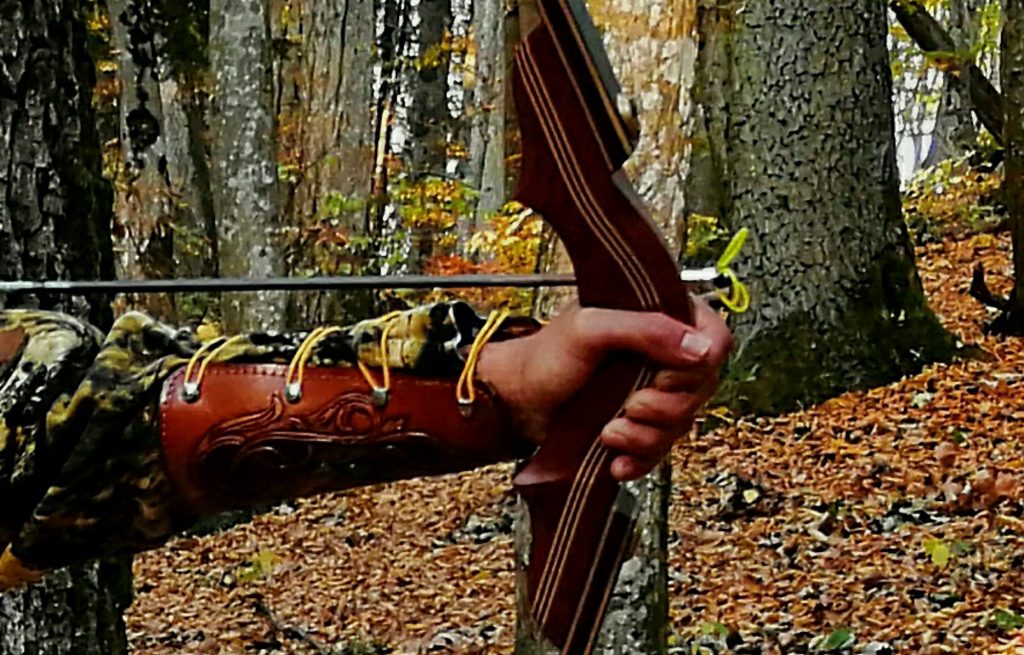
Roving: Free Shooting in the Field – The Original Form of Instinctive Archery
What is Roving?
Roving (also known as roving the butts or roving archery) refers to free, unstructured archery over unknown distances at natural or improvised targets—without fixed shooting positions, prior distance estimation, or repeatable stances.
The archer moves through forest, meadow, or hilly terrain and shoots once at a target of their choice—a rotten tree stump, a tuft of grass, a discarded tennis ball, or even a single leaf on a branch—then moves on.
There is no return, no adjustment, no second arrow.
Roving is not training for the hit—it is training for the decision.
Historical Origin
The term first appeared in 17th-century England, notably with the Royal Company of Archers (founded 1676), whose annual competition for the “Edinburgh Arrow” was held “at the rovers in Leith Links.”
The Royal Toxophilite Society (founded 1781) practiced roving as a social event: aristocrats walked through parks and countryside, shot at improvised targets, and celebrated together afterward.
Roger Ascham wrote in Toxophilus (1545): “The true archer learns not at the stand—but in the field.”
Roving was never a modern-style competition—it was a test of judgment under varying conditions.
Why Roving Matters Today
- It trains distance perception—not by measuring, but by experience
Without markers, the body learns to “feel” distance. The eyes provide data, but the decision arises from kinesthetic memory—through repetition in real terrain. - It reduces target fixation
Because the target is often small, indistinct, or moving (a leaf in the wind), success isn’t about hitting—it’s about making the right choice in the moment.
“You cannot control whether you hit—but you can control how you act.” - It builds terrain competence
Roving forces engagement with:
– Wind direction and strength
– Uneven ground
– Light conditions
– Sight lines
This is the foundation of 3D Archery and Archery Golf—both are modernized forms of roving. - It strengthens presence—not performance
Every shot is new. No routine. No automation.
The archer must be fully in the here and now—or the process fails.
It connects with nature—not technology - No gadgets. No stabilizers. No sights.
Just human, bow, terrain—and freedom.
Practical Application Today
Practical Application Today
For beginners: Short roving sessions (3–5 targets) after basic training—to sensitize to distance and terrain.
For advanced archers: Full-day roving tours with one arrow—each decision documented and reflected upon.
For groups: A “Roving Challenge”—each chooses a target, shoots once, and the group evaluates not just the hit, but the quality of preparation.
Conclusion: Roving as a Mindset
Roving is more than a method—it is a stance toward life:
“You don’t stand at a shooting line—you stand in life.
And there are no markers—only decisions.”
In an age of control, data, and optimization, roving offers something radical:
Trust in your own perception—despite uncertainty.
And that is precisely what makes it the most essential practice of instinctive archery.
Note on Legality in Europe
In Europe—particularly in Sweden—roving is generally permitted as long as it remains purely recreational practice and does not involve hunting. Thanks to the liberal Allemansrätten (Right of Public Access), you may walk and engage in activities in nature—as long as you do not disturb others, harm the environment, or shoot within approximately 150–200 meters of homes.