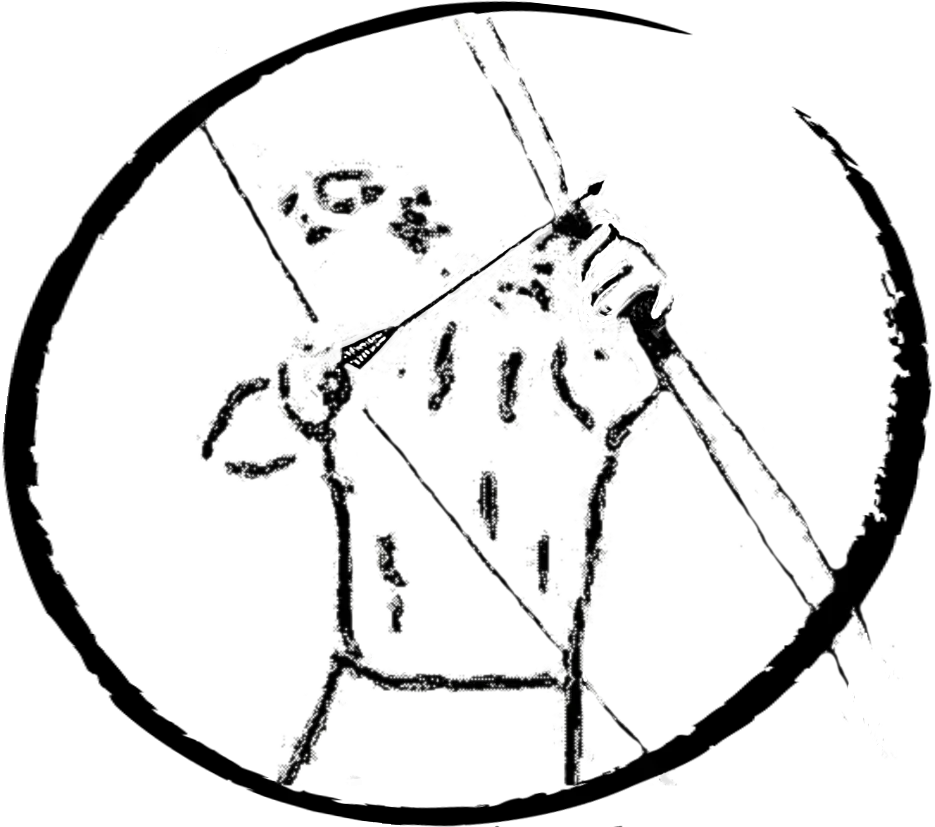
Allowing in Archery – Craft Over Esoterics
Many call it “release.” I call it allowing – because it is not an act of will, but the logical consequence of correct preparation.
Allowing is the final step in the shot sequence – and one of the most decisive.
Even with perfect stance, reference point, and breathing rhythm, a faulty allowing can compromise the entire shot.
“The bow does not teach aiming. It teaches trust.”
And trust arises from repetition, presence, and anatomical precision – not from words.
Why Allowing Matters
During allowing, the energy stored in the bow transfers to the arrow.
Clean allowing creates harmonic oscillation and a stable flight path.
Faulty allowing disrupts this dynamic – resulting in measurable dispersion.
Clarification:
Allowing does not happen by opening the fingers.
It occurs through the deliberate relaxation of the drawing hand once full back tension has been reached at the reference point.
Common Errors in Allowing – and Their Causes
1. Active Opening Instead of Allowing
The archer consciously tries to open the fingers.
→ Effect: lateral deflection of the arrow.
→ Cause: lack of trust in back tension.
2. Plucking (Lateral Pull of the Drawing Hand)
The hand moves outward away from the face, not parallel to the arrow’s flight path.
→ Effect: unstable arrow oscillation, left/right dispersion.
→ Cause: arm strength instead of scapular movement.
3. Premature Allowing
Shot occurs before the post-expiratory breath pause.
→ Effect: inconsistent flight path.
→ Cause: missing shot routine.
4. Lack of Follow-Through
Bow hand jerks forward; gaze shifts from target.
→ Effect: interrupted energy transfer.
→ Cause: treating the shot as an “event” rather than a process.
5. Incorrect Equipment
Draw weight too high; arrow not matched to bow.
→ Effect: compensatory postures.
→ Cause: missing bare shaft test.
Practical Solutions – No Esoterics
Dry-Fire with Resistance Band
Train soft, even finger relaxation – without active “letting go.”
Wall Drill Against Plucking
Stand sideways to a wall. The drawing hand must not touch it – ensuring straight movement.
Video Analysis
Check: Does the drawing hand move straight back? Or pull sideways?
Eyes-Closed Shooting
Reduces visual distraction. Enhances kinesthetic awareness.
Structured Shot Routine
Analysis → Preparation → Build-up → Allowing → Observation.
Clarity – not control.
What Doesn’t Help
- Clickers: disrupt natural allowing – they belong to sighted shooting.
- “Just relax!”: not instruction – just noise.
- Mental rehearsal or visualization: distracts from craft. The shot happens in the body – not the mind.
Who Is This For?
- Beginners who want to learn correctly from day one.
- Experienced archers who sense something is missing – but can’t name it.
- Students of Mellansken Archery School in Stockholm – and all who seek a handcraft-based approach to instinctive archery.
Want to Go Deeper?
Our Basis Training in Stockholm teaches these fundamentals systematically –
in small groups, in the forest, without esoterics.
No prior experience needed.
→ Kursanfrage / Course inquiry / Kursförfrågan
Allowing #InstinctiveArchery #ArcheryStockholm #MellanskenArchery #BarebowArchery #TrustNotAiming