The Essentials of Archery
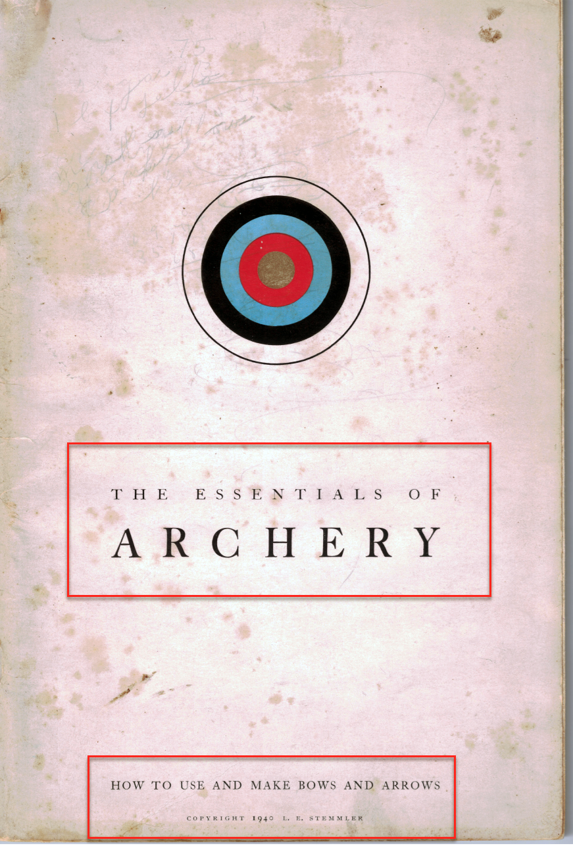
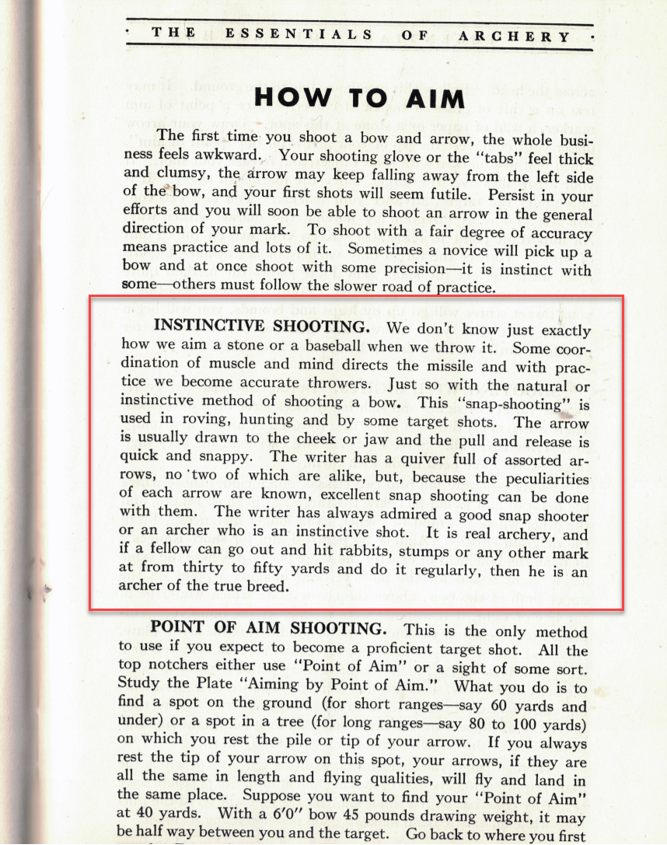
The term „instinctive archery“ is not a modern invention. It has clear historical roots reaching back into the 1920s and 1930s. This is documented at least as early as the first edition of L.E. Stemmler’s book „THE ESSENTIALS OF ARCHERY“ from 1940.
I say this not from second-hand knowledge. I, Uwe P. Tesch, own this original edition. I have hold the definitions and history in my own hands.
It seems counterproductive to simply rename this term „intuitive archery“ for marketing or modernization reasons. It is not a neutral change. Often, it is a simplification or marketing tactic that distorts the original meaning.
Here is a clarification—from a historical perspective and from the practice of over 30 years of coaching.
Historical Roots: A Learned Instinct
From a historical viewpoint, „instinctive shooting“ stems from the idea of a natural, learned instinct. It is about something that becomes second nature through practice—similar to throwing a stone. You do not consciously calculate angles or distance. Your body knows what to do.
In German, this is often translated as „instinktiv,“ emphasizing the aspect of the subconscious. „Intuitive,“ however, implies rather a spontaneous inspiration or feeling. That is not the same thing.
Sometimes „intuitive“ is used as a softer, more accessible term to appeal to beginners or market courses. But in doing so, the core is lost.
The Misconception: Innate vs. Learned
Some sources—even encyclopedias like Wikipedia in the article on „Traditional Archery“—use „intuitive shooting.“ They list advantages like hitting moving targets without mentioning the historical depth or nuances.
Others go so far as to dismiss „instinctive“ as „bullshit.“ The reasoning: It allegedly implies that archery is innate. That is naturally false. Archery is not innate. It is learned.
This is exactly where the difference lies:
Instinctive here means: Automated through practice.
It does not mean: You can do it from birth.
It means: Through thousands of repetitions, the process becomes so deeply anchored that it can be recalled without conscious control. This is not a mystical state. This is neurological reality.
Why Language Matters
It is not about „being right“ for me. Language evolves, and translations are subjective. „Instinctive“ is indeed equated with „intuitive“ in some contexts.
But if the core is lost in the process—namely the emphasis on trained instinct rather than pure intuition—misinformation arises. Especially in online sources, facts mix with opinions, complicating matters.
I believe one should respect the original term where possible. And one should clarify what it means.
The Essence at Mellansken Bågskola
With me, you learn instinctive archery. Not because it sounds better. But because it is more precise.
- It is not about sentimental feeling.
- It is not about innate talent.
- It is about discipline, repetition, and trust in your own body.
When you draw the bow, you should not think. You should act. But this action is the result of hard work. It is a craft.
„The Essentials of Archery“—the title of Stemmler’s book, which I own—still fits perfectly today. It is about the essentials. Not about marketing. Not about semantic acrobatics.
But about the shot. And the truth behind it.
Want to experience it? In my courses in Åkersberga, you learn the difference between feeling and instinct. Practical. Tangible. Without esotericism.
🏹 Mellansken Bågskola – Stockholm & Surroundings Here you go to courses & contact
#InstinctiveArchery #TraditionalArchery #ArcheryHistory #CraftNotEsotericism #MellanskenBågskola #ArcheryCoach #TrustNotAiming #LearnArchery #Stockholm #Åkersberga #Bowhunting #PrimitiveArchery #ArcheryLife #SwedenArchery